Air Compressor Setup Guide 2026: CFM Sizing & Installation
A well-designed compressed air system transforms your workshop capabilities. From powering nail guns to running paint sprayers and impact wrenches, the right compressor and piping system ensures you have consistent, dry air where and when you need it. This guide covers everything from CFM calculations to piping layout and moisture control.
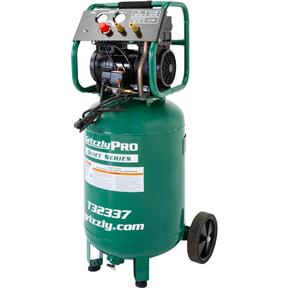
Buying a shop compressor? Grizzly Industrial offers both quiet portable and full-size shop compressors factory-direct, often priced lower than through a reseller and backed by full parts availability and U.S. support:
Understanding CFM and PSI
Two specifications define air compressor performance: CFM (Cubic Feet per Minute) measures volume of air delivered, while PSI (Pounds per Square Inch) measures pressure. Both matter, but for most shop applications, CFM is the more critical specification.
CFM Rating Confusion
Manufacturers rate CFM in various ways that can be misleading:
- Displacement CFM: Theoretical maximum based on pump geometry, meaningless for actual use
- Free Air CFM: Air delivered at atmospheric pressure, not what you get at working pressure
- SCFM (Standard CFM): Measured at standard conditions (68°F, 14.7 PSI, 36% humidity)
- ACFM (Actual CFM): What you actually get at your location's conditions
- CFM @ 90 PSI: The most useful specification, actual delivery at typical working pressure
Always compare CFM ratings at the same pressure, typically 90 PSI. A compressor rated at 10 CFM @ 40 PSI will deliver far less at 90 PSI. For the average draw of every common air tool, see our air tool CFM chart.
Calculate Your CFM Requirements
Use our calculator to determine the right compressor size based on your air tools.
Types of Air Compressors
Reciprocating (Piston) Compressors
The most common type for home and small commercial shops. A piston compresses air on each stroke, similar to an engine cylinder.
Single-Stage: Air is compressed once to final pressure (typically 100-125 PSI). Adequate for most shop needs, more affordable, runs hotter.
Two-Stage: Air is compressed in one cylinder, cooled, then compressed again in a second cylinder. More efficient, runs cooler, reaches higher pressures (up to 175 PSI), longer service life.
Rotary Screw Compressors
Used in professional and industrial settings. Two helical screws continuously compress air without pulsation. Very quiet, long service life, designed for continuous duty. Overkill and expensive for most home shops.
Oil-Free vs. Oil-Lubricated
Oil-Lubricated: Quieter, cooler operation, longer life, requires oil changes, can introduce oil into air stream (needs filtration for painting).
Oil-Free: No oil maintenance, no oil contamination risk, louder operation, shorter service life, often less expensive.
For general shop use, oil-lubricated compressors are typically the better long-term value. For dedicated finishing rooms where any oil contamination is unacceptable, oil-free makes sense.
Sizing Your Compressor
Step 1: Identify Your Tools
List every air tool you'll use and its CFM requirement:
- Brad nailer: 0.3 CFM, 60-120 PSI
- Finish nailer: 0.5-1.0 CFM, 70-120 PSI
- Framing nailer: 2.0-2.5 CFM, 70-120 PSI
- Stapler: 0.3-0.5 CFM, 70-100 PSI
- Blow gun: 2-3 CFM continuous, 90 PSI
- Spray gun (HVLP): 8-12 CFM continuous, 25-50 PSI
- Spray gun (conventional): 12-18 CFM continuous, 40-60 PSI
- Die grinder: 4-8 CFM, 90 PSI
- Angle grinder: 5-8 CFM, 90 PSI
- Impact wrench (3/8"): 3-5 CFM, 90 PSI
- Impact wrench (1/2"): 4-7 CFM, 90 PSI
- Orbital sander: 6-10 CFM, 90 PSI
- Sandblaster: 15-50 CFM, 90-125 PSI
Step 2: Calculate Total Requirements
For intermittent tools (nailers, impact wrenches), you can often run multiple tools from a smaller compressor since they're not continuous. The tank provides reserve.
For continuous tools (spray guns, sanders, grinders), your compressor must deliver at least the CFM the tool requires, continuously. Our best air compressors for garage and shop guide lists the rated CFM at 90 PSI for each pick so you can match it to your tool list.
Step 3: Add Safety Margin
Add 25-50% to your calculated requirement. This accounts for:
- Air leaks in aging systems
- Future tool additions
- Extended compressor life (not running at 100%)
- Pressure drops in piping
Tank Size Considerations
Tank size affects how long you can use air between compressor cycles (see the air compressor comparison table for tank sizes by model):
- Pancake (1-6 gallon): Portable, nailers only, frequent cycling
- Hot dog (2-6 gallon): Portable, light-duty, frequent cycling
- Twin stack (4-6 gallon): Portable, moderate capacity
- Wheelbarrow (8-20 gallon): Semi-portable, good for job sites
- Vertical (20-60 gallon): Stationary, good shop size
- Horizontal (60-80+ gallon): Stationary, professional duty
For spray painting and continuous-use tools, larger tanks reduce pressure fluctuations and allow the compressor more rest time between cycles.
Shop Air Piping
Piping Materials
- Black iron pipe: Traditional, durable, can rust internally (debris in air)
- Galvanized pipe: Resists corrosion better, but galvanizing can flake
- Copper: Excellent, corrosion-resistant, more expensive, requires soldering
- Aluminum: Excellent, corrosion-free, easy to install, professional-grade systems
- PVC: NEVER use for compressed air, can shatter catastrophically
PVC Warning
Never use PVC pipe for compressed air systems. Unlike hydraulic pipe failure, PVC can shatter explosively, sending shrapnel through your shop. This has caused serious injuries and deaths. Use only materials rated for compressed air.
Pipe Sizing
Undersized pipe causes pressure drop. For runs under 50 feet:
- Up to 10 CFM: 1/2" minimum
- 10-20 CFM: 3/4" minimum
- 20-50 CFM: 1" minimum
For longer runs, upsize pipe or add larger main header with smaller drops.
Loop vs. Dead-End Layout
A loop system (pipe runs in a circle around the shop) provides more consistent pressure at all outlets. Dead-end runs (single pipe to each outlet) are simpler but outlets far from the compressor may see pressure drop when other outlets are in use.
Moisture Control
Compressed air contains moisture that condenses as air cools. This water causes:
- Fish-eye defects in finishes
- Rust in air tools and work pieces
- Frozen regulators in cold weather
- Tool damage over time
Moisture Control Components
- Aftercooler: Cools compressed air immediately after compressor, condensing moisture while still centralized
- Water separator: Centrifugal separator removes liquid water from air stream
- Refrigerated dryer: Cools air to condense moisture, then reheats (professional systems)
- Desiccant dryer: Absorbs moisture chemically (best for critical applications)
- Point-of-use filters: Final filtration at each outlet
Piping for Moisture Control
- Slope pipes away from compressor (1/4" per 10 feet)
- Install drain legs at low points
- Take drops from the top of horizontal pipes (water falls, air rises)
- Install automatic drain valves on tanks and filter bowls
Common Air Tool Requirements
Woodworking Air Tools
- Pin nailer: Ultra-fine work, minimal CFM
- Brad nailer: Trim, molding, light assembly
- Finish nailer: Heavier trim, face frames, furniture
- HVLP spray gun: High-quality finish work, requires significant CFM
- Blow gun: Dust removal, cleaning
Automotive Air Tools
- Impact wrench: Lug nuts, suspension work
- Air ratchet: Faster than manual, tight spaces
- Die grinder: Grinding, cutting, polishing
- Air hammer: Rust removal, panel work
- Sandblaster: Surface prep, rust removal, high CFM demand
Maintenance Schedule
Daily
- Drain tank condensate
- Check oil level (if applicable)
- Drain water separators
Weekly
- Check belt tension
- Inspect air filter
- Check for unusual noises or vibration
Monthly
- Clean air filter (replace if damaged)
- Inspect all connections for leaks
- Check safety valve operation
Annually
- Change oil (oil-lubricated units)
- Replace air filter
- Inspect valves and gaskets
- Check pressure switch calibration
Recommended Air Compressors
California Air Tools 10020C
Ultra quiet (70dB), 10 gallon, 2 HP, oil-free. 5.3 CFM @ 90 PSI. Perfect for shops near living spaces with 3000+ hour pump life.
DeWalt DXCMV5076055 60-Gallon
5 HP, two-stage, 175 PSI max, 15.5 CFM @ 90 PSI. Cast iron pump with TOPS motor protection. Professional-grade for serious shops.
California Air Tools 20020
Ultra quiet (70dB), 20 gallon, 2 HP, oil-free. 5.3 CFM @ 90 PSI. Larger tank for extended run time on spray guns and sanders.