Best Drill Presses 2026: Benchtop & Floor Standing Picks Ranked
What is the best drill press for your shop? Whether you need a heavy-duty floor-standing model for precision metalwork or a compact benchtop unit for weekend woodworking, this guide covers every price point and use case. We have evaluated the 7 best drill presses for 2026, from the JET JDP-17MF 17" Floor Drill Press (under $2,500) down to budget benchtop models under $200. After analyzing specifications, spindle runout measurements, speed ranges, and thousands of owner reviews, here are the drill presses that deliver the best accuracy, power, and value for your money. Need to figure out your tap drill sizes first? Use our Drill & Tap Calculator to find the right bit for any thread. Only want a bench-mounted machine? See our dedicated best benchtop drill presses guide.
For a benchtop machine with room to grow, the Grizzly T34608 15 in benchtop drill press (3/4 HP, 15-1/4 in swing, 12 speeds from 250 to 3,100 RPM) is the direct-buy pick; on Amazon the closest match is the WEN DP1263V.
Quick Picks: Best Drill Presses 2026
Short on time? Here are our top recommendations for different needs and budgets:

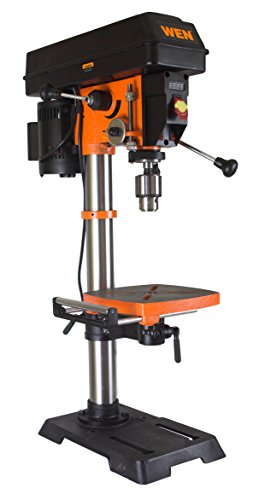
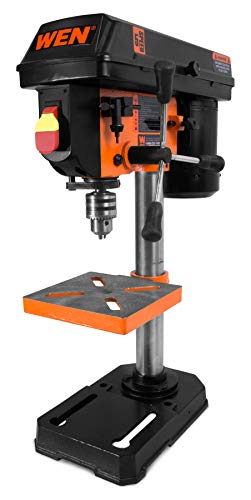

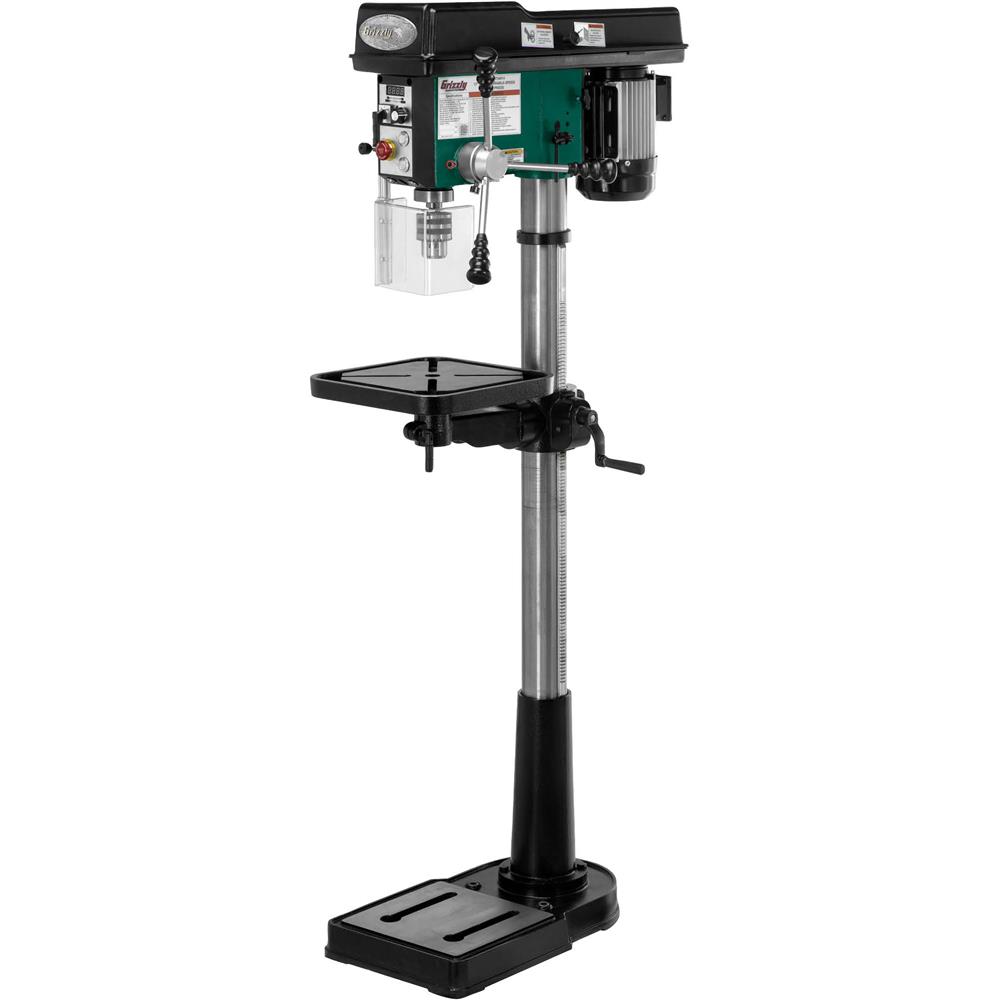
Prefer to buy direct? The Grizzly T34614 17" Floor Variable-Speed Drill Press is a strong floor drill press from Grizzly Industrial, often priced lower factory-direct than through a reseller and backed by full parts availability and U.S. support.
Shop the T34614 at Grizzly.com →How We Evaluated
Our Evaluation Criteria
We evaluated each drill press based on the metrics that matter most to woodworkers and metalworkers: spindle accuracy, speed range flexibility, build rigidity, table quality, and overall value for money. A drill press lives or dies by its precision, so runout and repeatability were weighted heavily in our scoring.
Spindle Accuracy
Published runout specs and owner-reported quill play and repeatability of the spindle and chuck
Speed Range
Number of speed settings, RPM range, and ease of speed changes for different materials
Build Rigidity
Column stiffness, table flatness, head casting quality, and vibration dampening
Value for Money
Performance relative to price point, included accessories, and long-term durability
Beyond these core criteria, we also considered spindle travel depth (how deep you can drill in a single stroke), table size and T-slot configuration, dust port availability, and the quality of the depth stop mechanism. For woodworkers, we paid attention to fence compatibility and how well each model handles Forstner bits and hole saws. For metalworkers, we looked at low-speed torque, table rigidity under load, and compatibility with drill press vises. Every drill press was evaluated against models in its own price class, because the best $150 benchtop press has entirely different strengths than the best premium floor model.
Detailed Product Reviews
JDP-17MF 17" Floor Drill Press
Best OverallThe JET JDP-17MF is our top pick for serious woodworkers and metalworkers who demand precision, power, and longevity from their drill press. The 3/4 HP motor is paired with a 16-speed range (200-3,600 RPM), which covers everything from slow-speed metal drilling to high-RPM wood boring. The 17-inch swing accommodates large workpieces without repositioning, and the 4-5/8 inch spindle travel handles deep boring in thick stock. Where the JET truly shines is in build quality: the head casting is heavy and rigid, spindle runout is minimal out of the box, and the rack-and-pinion table adjustment operates smoothly under load. The large cast iron table includes T-slots for secure clamping, and the depth stop provides precise, repeatable depth control. This is the drill press you buy once and use for decades.
Pros
- Exceptional build quality and rigidity
- 16-speed range covers wood and metal applications
- Minimal spindle runout out of the box
- Large 17-inch swing for big workpieces
- Smooth rack-and-pinion table adjustment
- Heavy cast iron construction dampens vibration
Cons
- Premium price point
- Heavy (over 350 lbs) - requires planning for placement
- Belt changes required for speed adjustment
DP1263V 12" Variable Speed Benchtop Drill Press
Best BenchtopThe WEN DP1263V is the best benchtop drill press you can buy under $500, and it competes favorably with models costing twice as much. The variable speed motor (580-3,100 RPM) is the standout feature here, allowing you to dial in the perfect RPM for any material without stopping to change belts. The 6.2-amp motor provides adequate power for drilling in hardwoods and mild steel, though it will bog down on larger bits in thick metal. The 12-inch swing and 3-1/8 inch spindle travel handle the majority of home workshop tasks. WEN includes a laser crosshair for precise bit alignment, a work light for visibility, and a keyed 5/8-inch chuck that accepts larger bit shanks than most benchtop competitors. The cast iron table with T-slots provides a solid work surface, and the digital speed readout takes the guesswork out of RPM selection.
Pros
- Variable speed eliminates belt changes
- Digital speed readout for precise RPM control
- Laser crosshair for accurate bit alignment
- 5/8-inch chuck accepts larger shanks
- Excellent value for the feature set
- Built-in work light
Cons
- Plastic housing on the head
- Table could be larger for some applications
- Motor may struggle with large bits in metal
4206T 8" 5-Speed Drill Press
Budget PickThe WEN 4206T proves that accurate drilling does not require a large investment. At under $250, this 8-inch benchtop drill press delivers surprisingly good performance for hobby woodworkers, crafters, and anyone who needs consistently perpendicular holes without breaking the bank. The 5-speed pulley system (740-3,140 RPM) covers basic wood and soft metal drilling, and the 1/3 HP motor handles bits up to 1/2 inch in softwood without complaint. The 2-inch spindle travel is the main limitation, restricting you to thinner stock, but for the vast majority of small shop tasks this is not an issue. The cast iron base and worktable provide stability that belies the low price, and the 1/2-inch keyed chuck holds bits securely. For the price, the 4206T is a strong entry-level drill press.
Pros
- Unbeatable price for a quality drill press
- Over 6,500 positive reviews on Amazon
- Cast iron table and base for stability
- Compact footprint saves bench space
- Adequate for most hobby woodworking tasks
- Simple, reliable belt-and-pulley speed changes
Cons
- Only 2 inches of spindle travel
- Limited 8-inch swing capacity
- Motor underpowered for hardwoods and metal
- No work light or laser guide
W1848 20" Floor Drill Press
Best Heavy DutyThe JET JDP-20S is a serious machine for serious work. With a 20-inch swing, 1.5 HP motor, and 12-speed gearbox, it handles everything from large panel drilling to heavy steel boring with authority. The 20-inch swing is the largest in our roundup, allowing you to center holes in stock up to 20 inches wide without repositioning. The 12-speed range extends down to low RPMs suitable for large-diameter metal drilling, and the powerful motor maintains torque even under heavy load. The massive cast iron column and head virtually eliminate vibration, resulting in clean holes and extended bit life. The 4-3/4 inch spindle travel drills through standard dimensional lumber in a single pass, and the large cast iron table with T-slots provides generous clamping area. Shop Fox backs this machine with solid support and readily available replacement parts. If your work demands the biggest swing and the most capable drill press under $2,000, the W1848 delivers.
Pros
- Largest swing capacity (20") in our roundup
- Powerful 1.5 HP motor handles heavy loads
- 12-speed range includes low RPM for metal
- Massive cast iron construction eliminates vibration
- Large table with T-slots for secure clamping
- Solid Shop Fox support and parts availability
Cons
- Very heavy (over 400 lbs)
- Requires significant floor space
- Needs 220V power in some configurations
- Higher price point
10" 5-Speed Benchtop Drill Press
Best Value BenchtopThe WEN 10-inch benchtop press occupies the sweet spot between bare-bones budget models and full-featured benchtop drill presses. It costs only slightly more than the cheapest options but includes features typically found on more expensive machines. The 10-inch swing gives you 2 extra inches over 8-inch models, which makes a real difference when working with wider stock. The 6.2-amp motor is adequate for wood drilling and light metalwork, and the 5-speed pulley system provides reasonable flexibility. What sets this press apart at the price is the included laser guide for bit alignment, cast iron construction for stability, and built-in chuck key storage so the key is never missing when you need it. For woodworkers who want more capability than a basic 8-inch press without jumping to the $300+ category, the WEN hits the mark.
Pros
- Laser guide at a budget price
- 10-inch swing beats 8-inch budget competitors
- Cast iron construction
- Built-in chuck key storage
- Good build quality for the price
- Compact and lightweight for easy placement
Cons
- Motor is modest for demanding tasks
- Belt-and-pulley speed changes less convenient
- Limited to 5 speed settings
- Not ideal for metal drilling
JDP-15F 15" Floor Drill Press
Editor's ChoiceThe JET JDP-15F delivers the combination of capacity, precision, and long-term support that earns it our Editor's Choice designation. The 15-inch swing covers most furniture and cabinet work, while the 3/4 HP motor keeps it on standard 115V household power. The 16-speed range covers virtually any drilling application in wood or metal, from slow large-diameter boring to high-speed small bits. JET floor presses have a decades-long reputation in professional shops, owner reviews consistently praise the rigid column and flat table, and JET backs the machine with one of the best parts and warranty networks in the category. It offers floor-model capability without stepping up to an industrial machine, making it an excellent choice for the workshop that needs capacity and precision that will last decades.
Pros
- Floor-model capacity on 115V household power
- 15-inch swing at a fair mid-range price
- 16-speed range for wood and metal
- Rigid cast iron column and table
- JET warranty and parts network
- Proven design used in professional shops
Cons
- 3/4 HP motor less powerful than 1+ HP competitors
- Belt changes required for speed adjustment
- Needs floor space, not a benchtop
4227T 13-Amp 12-Speed Floor Drill Press
Best Mid-RangeThe WEN 4227T sits in the sweet spot between benchtop convenience and heavyweight floor-model capability, making it an ideal choice for the home woodworker who has outgrown a benchtop press but does not need a massive industrial machine. The 13-amp motor delivers solid performance for woodworking tasks including large Forstner bits, hole saws, and drum sanding attachments. The 12-speed pulley system provides enough range for both wood and light metal drilling, and the belt-and-pulley design delivers consistent torque at lower speeds. WEN has earned a loyal following among home woodworkers for building solid, no-nonsense machines at fair prices, and owner reviews of the 4227T consistently mention the value for a full floor press. At well under four figures, it undercuts the premium floor models significantly while delivering most of their capability for typical home workshop use.
Pros
- Excellent balance of price and capability
- 12-speed range covers wood and light metal
- Strong 13-amp motor for most woodworking tasks
- Full floor-standing capacity
- Compact floor model footprint
- Strong value reputation among owners
Cons
- Fit and finish below JET and Powermatic
- Belt changes required for speed adjustment
- Stock table is basic, aftermarket tables help
- Availability fluctuates
Find the Right Drill & Tap Size
Use our Drill & Tap Calculator to determine the correct drill bit size for any thread pitch, including UNC, UNF, and metric threads.
What Size Drill Press Do I Need?
Choosing the right drill press size depends on what you are building, the materials you work with, and how much shop space you have. "Size" in drill press terms refers to the swing, which is twice the distance from the center of the spindle to the nearest edge of the column. A 14-inch drill press can drill to the center of a 14-inch wide workpiece. Here is a quick reference to help you choose the right size:
| Use Case | Recommended Swing | Type | Typical HP | Our Pick |
|---|---|---|---|---|
| Light hobby, small parts | 8-10 inches | Benchtop | 1/3 - 1/2 HP | WEN 4206T |
| General woodworking | 12-14 inches | Benchtop or Floor | 1/2 - 3/4 HP | WEN DP1263V |
| Furniture making, metalwork | 15-17 inches | Floor | 3/4 - 1.5 HP | JET JDP-17MF |
| Large panels, production work | 18-20 inches | Floor | 1 - 1.5 HP | JET JDP-20S |
| Benchtop with room to grow | 15 inches | Benchtop | 3/4 HP | Grizzly T34608 15 in |
Pro Tip: Swing size gets most of the attention, but spindle travel is just as important for practical work. Spindle travel determines the maximum depth you can drill in a single plunge. Most benchtop models offer 2-3.5 inches of travel, while floor models typically provide 3.5-6 inches. If you frequently drill through thick stock or use long Forstner bits, prioritize spindle travel. For exact drill bit sizing, refer to our Drill Bit Sizes Reference Chart or the Pilot Hole Chart for wood screws.

Photo via Unsplash
Complete Buying Guide: What to Look For
Before purchasing a drill press, understanding these key factors will help you make an informed decision that matches your workshop needs and the materials you work with most often.
Motor Power
Motor power directly determines how well a drill press handles large-diameter bits, hard materials, and sustained use without bogging down. Drill press motors are rated in horsepower (HP) or amps:
| Power Rating | Best For | Typical Applications |
|---|---|---|
| 1/3 HP (2-3A) | Light-duty benchtop work | Small holes in wood and plastic, PCB drilling, craft work |
| 1/2 HP (3-5A) | General-purpose benchtop | Wood drilling up to 1 inch, thin metal, general shop tasks |
| 3/4 HP (6-8A) | Mid-range floor models | Hardwood boring, mild steel, Forstner bits up to 2 inches |
| 1 - 1.5 HP (8-12A) | Heavy-duty floor models | Large hole saws, thick steel, production drilling, mortising |
Important: An underpowered motor is the most common source of frustration with a drill press. When a motor bogs down, it generates heat, reduces accuracy, and wears components prematurely. If you are between two sizes, always go with more power. The difference in cost is small, but the difference in capability is significant.
Swing Size
The swing measurement tells you the maximum width of workpiece you can center under the drill bit. It equals twice the distance from the spindle center to the front face of the column:
- 8-10 inch swing: Suitable for small parts, jewelry making, and light hobby work. Limited to centering holes in stock up to 8-10 inches wide.
- 12 inch swing: The most popular benchtop size. Handles the majority of home workshop tasks including shelf drilling, box making, and small furniture parts.
- 14-15 inch swing: The sweet spot for serious woodworkers and general metalworkers. Drills to the center of cabinet sides and wide boards without repositioning.
- 17-20 inch swing: Full-size floor models for furniture makers, cabinet shops, and anyone working with large panels or wide stock regularly. These machines also deliver more rigidity for precision metalwork.
Keep in mind that the column limits how far back you can position the workpiece. For holes near the edge of a board, swing rarely matters. But for centering holes in wide panels, a larger swing prevents the frustrating workaround of clamping material off to one side. For a detailed comparison of benchtop versus floor-standing models, see our Benchtop vs. Floor Drill Press Comparison.
Spindle Travel
Spindle travel (also called quill travel) is the distance the spindle moves downward in a single stroke when you pull the feed handle. This determines the maximum depth you can drill without raising the table or repositioning the workpiece:
- 2-2.5 inches: Typical of budget benchtop models. Adequate for thin stock but limiting for thicker hardwoods or deep boring operations.
- 3-3.5 inches: Standard on quality benchtop and entry-level floor models. Handles most general woodworking and metalworking tasks.
- 4-4.5 inches: Found on mid-range floor models. Drills through standard dimensional lumber (up to 3.5 inches thick) in a single pass.
- 5-6 inches: Premium floor models. Required for thick timber, stacked drilling, and deep mortising operations.
Depth stop quality matters too. A good depth stop mechanism allows you to set a precise drilling depth and repeat it across dozens of workpieces without variation. Look for a threaded rod with locking nuts rather than a simple collar, as threaded stops provide finer adjustment and better repeatability.
Speed Range
Different materials and bit sizes require different spindle speeds for clean, efficient cutting. The wider the speed range and the more speed options available, the more versatile the drill press. See our drill speed chart for recommended RPMs by material and bit size:
| Material | Small Bits (under 1/4") | Medium Bits (1/4" - 1/2") | Large Bits (over 1/2") |
|---|---|---|---|
| Softwood | 2,500-3,000 RPM | 1,500-2,500 RPM | 500-1,000 RPM |
| Hardwood | 2,000-2,500 RPM | 1,200-2,000 RPM | 400-800 RPM |
| Mild Steel | 1,500-2,500 RPM | 600-1,200 RPM | 200-500 RPM |
| Stainless Steel | 500-1,000 RPM | 250-500 RPM | 100-250 RPM |
| Aluminum | 2,500-3,000 RPM | 1,500-2,500 RPM | 800-1,500 RPM |
Variable speed vs. belt-and-pulley: Variable speed models let you dial in exact RPMs with a knob or lever while the machine is running, which is extremely convenient. Belt-and-pulley systems require you to stop the machine, open the top cover, and manually move the belt between pulleys. However, belt-driven systems often deliver more consistent torque at low speeds, which matters for metalwork. The best drill presses, like the JET JDP-17MF, combine mechanical speed ranges with electronic variable speed for both torque and convenience.
Table Quality
The drill press table is your primary work surface, and its quality directly affects accuracy and usability:
- Size: Larger tables support bigger workpieces and provide more clamping area. A table around 12 x 12 inches is minimum for serious work. Premium models offer 16 x 16 inches or larger.
- T-slots: Machined T-slots allow you to secure fences, vises, and clamps directly to the table. More T-slots mean more clamping flexibility.
- Flatness: A flat, ground table surface ensures workpieces sit level. Check for warping on cast iron tables, especially on budget models.
- Tilt: Most tables tilt left and right (typically 45 degrees each way) for angled drilling. A positive stop at 0 degrees ensures you can return to square reliably.
- Height adjustment: Rack-and-pinion table height adjustment is far superior to the clamp-and-slide method on budget models. Rack-and-pinion lets you raise and lower the table precisely with a crank handle, even under load.
Cast iron tables are standard and preferred because they dampen vibration and resist wear. Avoid drill presses with stamped steel tables, as they flex under pressure and do not stay flat over time.
Chuck Type
The chuck holds your drill bit and its quality directly impacts accuracy, convenience, and bit grip strength:
- 1/2-inch keyed chuck (JT33 taper): The standard for most drill presses. Accepts bit shanks up to 1/2 inch. Reliable grip, minimal slippage, and widely available replacements. This is the best all-around choice.
- 5/8-inch keyed chuck: Found on larger floor models. Accommodates bits with larger shanks, useful for heavy-duty hole saws and large twist bits.
- Keyless chuck: Convenient for quick bit changes but may slip under heavy feed pressure, particularly with larger bits in metal. Best suited for light-duty and woodworking applications.
- Morse taper (MT2 or MT3): Some premium models accept Morse taper tooling directly in the spindle, bypassing the chuck entirely. This provides the best possible accuracy and zero runout for precision work.
Chuck runout is the amount of wobble at the tip of a drill bit. Budget chucks may exhibit 0.005 inches or more of runout, which causes oversized holes and poor finish quality. Quality chucks hold runout under 0.002 inches. If your drill press has excessive runout, upgrading to a premium chuck is one of the most cost-effective accuracy improvements you can make.
Metalworking Consideration
If you plan to drill metal regularly, prioritize low-speed capability (under 300 RPM), a rigid column, and a quality drill press vise. A wobbly column or inadequate clamping in metal drilling is both inaccurate and dangerous. For more on setting up a metalworking space, see our Metalworking Shop Setup Guide.
🔗 Need to cut slots and face parts, not just drill? See the best benchtop milling machines and mini mills.
Upgrade Pick and What You'll Also Need
A drill press arrives with a bare table. These are the add-ons that make it accurate and safe, plus the step up.
- Upgrade pick: the JET JDP-17MF, a 17 inch floor press with 16 speeds and the capacity for furniture and metal work.
- A drill press vise: the Wilton 4 in. low-profile drill press vise holds small and metal parts safely instead of your hand.
- A table with a fence: the WEN DPA2412T 24 x 12 in. table with fence and stop block makes repeat holes and doweling fast.
- Forstner bits: the Diablo 7-piece Forstner set covers hinge cups and flat-bottom holes; a drill press is where Forstner bits work best.
Outfitting the whole shop? Our workshop setups list complete tool sets for a beginner, intermediate and pro shop.
Deal season note: Prices on these often drop during Prime Big Deal Days and Black Friday. The picks and prices above were checked against live Amazon listings for 2026; if a price looks different when you click through, the listing has changed since.
Sources
- WEN and JET drill press specifications and manuals (manufacturers)
- OSHA machine guarding guidance (29 CFR 1910.212)
Researched from published specifications and standards, not hands-on testing.
Frequently Asked Questions
For most home workshops, a 12-inch to 14-inch drill press handles the majority of tasks. The swing size determines the maximum width of material you can center under the bit. A 12-inch press drills to the center of a 12-inch workpiece. If you regularly work with large panels, cabinet sides, or wide stock, step up to a 17-inch or 20-inch floor model like the JET JDP-17MF. For light-duty work and small parts, an 8-inch or 10-inch benchtop unit like the WEN 4206T is sufficient and budget-friendly.
Benchtop drill presses are compact, affordable ($100-$350), and adequate for light to moderate drilling in wood, plastic, and thin metal. Floor-standing models offer more power (typically 3/4 HP to 1.5 HP), larger swing capacity, longer spindle travel, and greater rigidity for demanding tasks. Choose a benchtop model if you have limited space or a small budget. Choose a floor model if you need precision, power, and the ability to drill through thick stock consistently. For a full breakdown, read our Benchtop vs. Floor Drill Press Comparison.
Wood drilling generally uses higher speeds: 1,500-3,000 RPM for small bits and 500-1,500 RPM for larger Forstner or spade bits. Metal drilling requires much lower speeds: 500-1,500 RPM for small bits in mild steel, and as low as 100-300 RPM for large bits or harder metals like stainless steel. A drill press with a wide speed range (200-3,600 RPM) and at least 12 speed settings gives you the flexibility to work both materials effectively. Variable speed models like the WEN DP1263V offer the most convenient adjustment. Consult our Drill Bit Sizes Reference for specific speed recommendations by bit diameter.
A drill press is one of the most versatile and underrated tools in any workshop. It delivers perfectly perpendicular holes every time, which is nearly impossible with a handheld drill. Beyond drilling, it handles sanding with drum attachments, mortising with the right jig, and even pattern routing with accessories. For woodworking joinery, metalwork, or any task requiring repeatable precision and consistent depth, a drill press pays for itself quickly. Even a budget under $250 benchtop model like the WEN 4206T dramatically improves hole accuracy over handheld drilling.
Most drill presses come with a 1/2-inch keyed chuck, which accepts bit shanks up to 1/2 inch in diameter. This is the standard and works well for the vast majority of woodworking and general metalworking tasks. A 5/8-inch chuck is available on some larger floor models and is beneficial if you frequently use large-diameter bits with thick shanks. Keyless chucks offer convenience for quick bit changes but may slip under heavy loads. For precision work, a quality keyed chuck with a JT33 taper provides the most reliable grip. Check our Drill & Tap Calculator to determine the exact bit sizes you will need for your projects.
A drill press is not designed for milling and should not be used as a substitute for a milling machine. Drill press spindle bearings are designed to handle axial (downward) loads, not the lateral forces generated during milling. Using a drill press as a mill can damage the bearings, bend the spindle, and create dangerous situations. For light slotting or fly-cutting in soft materials like aluminum or wood, some machinists use a drill press with an XY vise, but this is a compromise with significant limitations. If you need milling capability, invest in a proper mill-drill or benchtop milling machine. For more on metalworking equipment, see our Metalworking Shop Setup Guide.
Final Recommendations
After thorough evaluation, here are our recommendations for different scenarios:
Best Overall Drill Press (Our #1 Pick)
The JET JDP-17MF 17" Floor Drill Press is our top recommendation for any woodworker or metalworker who wants a drill press they will never outgrow. The 3/4 HP motor is enough for wood and typical metal drilling when you pick the right speed, the 16-speed belt-and-pulley range covers everything from slow metal drilling to high-speed wood boring, and the 17-inch swing handles large workpieces with ease. JET's build quality is exceptional, with minimal spindle runout and a rock-solid column that eliminates vibration. This is the drill press serious workshop owners wish they had bought first.
Best Benchtop Drill Press
The WEN DP1263V 12" Variable Speed delivers the best combination of features, accuracy, and value in the benchtop category. The variable speed motor (580-3,200 RPM) eliminates the hassle of belt changes and covers both wood and metal applications. The 12-inch swing handles most home workshop tasks, and the laser crosshair ensures precise bit alignment. At under $500, it outperforms drill presses costing twice as much.
Best Budget Drill Press
The WEN 4206T 8" Drill Press proves that you do not need to spend a fortune to get accurate, repeatable drilling. At under $250, it is the most affordable drill press worth buying. The 5-speed pulley system covers basic wood and soft metal drilling, and the cast iron table provides a stable work surface. If you are on a tight budget or just need a drill press for occasional use, start here.
Best Heavy Duty Drill Press
The JET JDP-20S 20" Floor Drill Press is built for the workshop that demands maximum capacity and power. With a 20-inch swing, 1.5 HP motor, and 12-speed gearbox reaching down to low RPMs for metal drilling, it handles everything from large panel drilling to heavy steel work. The massive cast iron construction virtually eliminates vibration, and the oversized table provides generous clamping area. If your work demands the biggest and most capable drill press, this is it.
Ready to Size Your Drill Bits?
Use our Drill & Tap Calculator to determine the correct drill bit for any thread size, or browse our Drill Bit Sizes Reference and Pilot Hole Chart for complete sizing tables.
Affiliate Disclosure: WorkshopCalc is reader-supported. When you buy through links on our site, we may earn an affiliate commission at no additional cost to you. This helps us maintain and improve our free calculators and guides. We only recommend products we believe provide genuine value to woodworkers.