Benchtop vs Floor Drill Press: Which Is Right for You?

Photo via Unsplash
Choosing between a benchtop and floor drill press is one of the most important tool decisions for any workshop. This comprehensive drill press buying guide compares capacity, power, features, and value to help you find the perfect drill press for your needs and budget.
Quick Verdict
Choose a benchtop drill press if you have limited space, work primarily with wood and light metal, and need portability. Choose a floor drill press if you need maximum capacity, work with large stock or heavy metals, and have dedicated shop space. Most hobbyist woodworkers will be well-served by a quality benchtop model, while serious metalworkers and production shops benefit from floor models.
Featured Products
WEN DP1263V 12-Inch Variable Speed Drill Press
Best value benchtop - variable speed, laser crosshair guide, digital readout.
Check PriceJET J-2530 15-Inch Bench Model Drill Press
Premium benchtop option with 15-inch swing and 16 speeds.
Check PricePowermatic PM2800B 18-Inch Drill Press
Premium floor model with DVR technology and 6-inch quill travel.
Check Price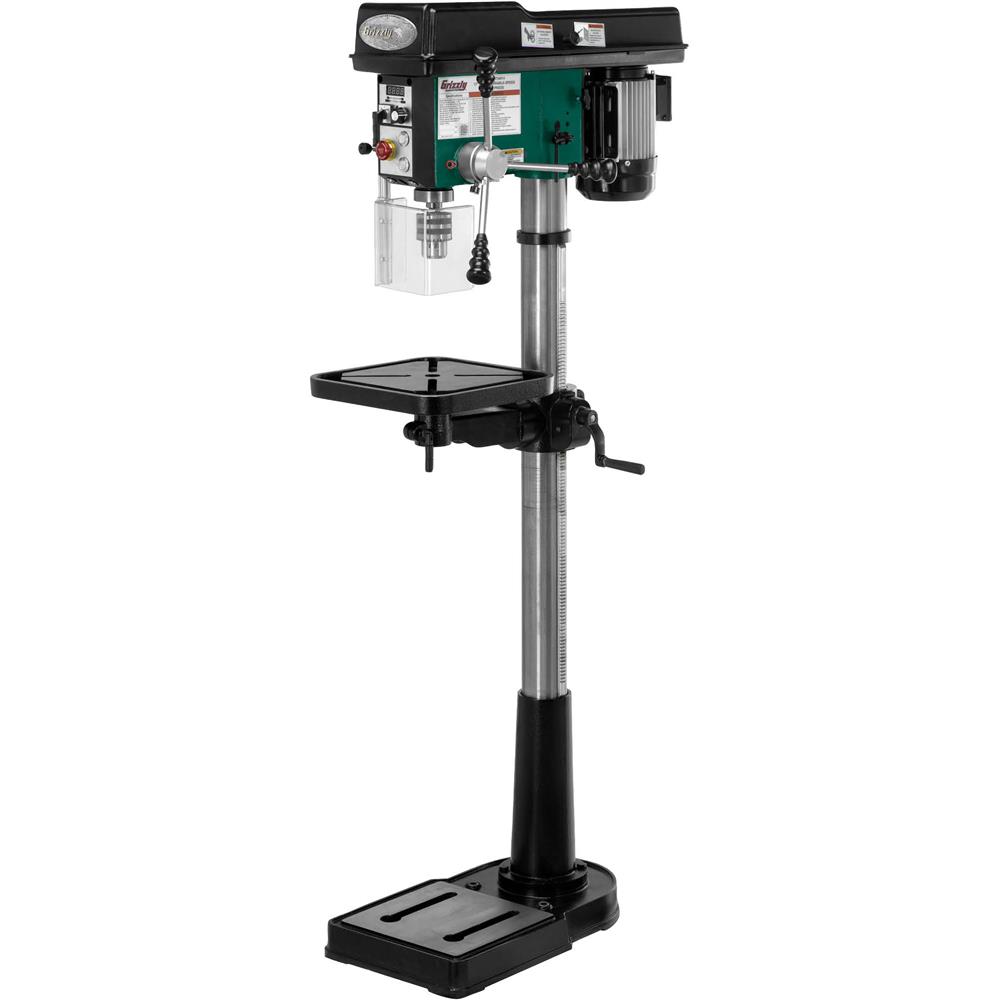
Stepping up to a floor model? The Grizzly T34614 17" Floor Variable-Speed Drill Press is a strong floor drill press from Grizzly Industrial, often priced lower factory-direct than through a reseller and backed by full parts availability and U.S. support.
Shop the T34614 at Grizzly.com →Quick Comparison Table
Before diving into the details, here is a side-by-side comparison of benchtop vs floor drill presses across key specifications:
| Specification | Benchtop Drill Press | Floor Drill Press | Winner |
|---|---|---|---|
| Swing (Throat Capacity) | 8-12 inches typical | 15-20 inches typical | Floor |
| Quill Travel | 2-3.5 inches | 4-6 inches | Floor |
| Motor Power | 1/3 - 3/4 HP | 3/4 - 1.5 HP | Floor |
| Footprint | 12-18 inches (on bench) | 18-24 inches (floor space) | Benchtop |
| Price Range | $150 - $600 | $500 - $2,500+ | Benchtop |
| Portability | Can be moved, 50-80 lbs | Stationary, 200-400+ lbs | Benchtop |
| Spindle to Table Distance | 10-15 inches max | 20-30+ inches adjustable | Floor |
| Table Size | 8x8 to 10x10 inches | 12x12 to 16x16 inches | Floor |
| Speed Range | 500-3,000 RPM (5 speeds) | 150-4,000 RPM (12-16 speeds) | Floor |
| Rigidity/Runout | Good (0.003-0.005") | Excellent (0.001-0.003") | Floor |
| Best For | Hobbyists, small shops, wood | Production, metal, large stock | Depends on use |

Photo via Unsplash
When to Choose a Benchtop Drill Press
A benchtop drill press is the right choice for many woodworkers and hobbyists. Here are the situations where a benchtop model makes the most sense:
Limited Workshop Space
If your shop is in a garage that also houses vehicles, a basement with limited ceiling height, or a small dedicated space, a benchtop drill press preserves valuable floor space. These units can be mounted on an existing workbench or a dedicated stand, and some can even be stored on a shelf when not in use.
Primarily Woodworking Projects
For drilling holes in wood, a benchtop drill press provides all the power and precision you need. Woodworking rarely requires the extreme rigidity or low-speed capabilities needed for metalwork. A 1/2 HP benchtop model easily handles forstner bits, doweling, and general drilling in hardwoods.
Budget Constraints
Quality benchtop drill presses start around $150-200, with premium models in the $300-600 range. This allows you to get a reliable tool while preserving budget for other shop equipment. The price difference between a good benchtop and floor model can fund a quality bandsaw or router table.
Portability Needs
If you need to move your drill press between locations, take it to job sites, or simply rearrange your shop frequently, the 50-80 pound weight of a benchtop model is manageable for one person. Floor models at 200-400+ pounds are essentially permanent fixtures.
Occasional Use
If drilling is an occasional operation rather than a daily task, investing in a floor model may not be justified. A benchtop press handles intermittent use perfectly well and represents better value for occasional users.
When to Choose a Floor Drill Press
Floor drill presses represent a significant step up in capability. Choose a floor model in these scenarios:
Working with Large Stock
The dramatically larger swing of a floor drill press (15-20 inches vs 8-12 inches) means you can drill holes at the center of much wider workpieces. For furniture makers, cabinet builders, or anyone working with wide panels, this capacity is essential.
Metal Fabrication
Metalworking demands low speeds (often under 500 RPM for large holes in steel), exceptional rigidity, and sustained power. Floor drill presses deliver on all counts with their heavier construction, more powerful motors, and wider speed ranges that extend into the low RPMs needed for metalwork.
Deep Hole Drilling
With 4-6 inches of quill travel versus 2-3.5 inches on benchtop models, floor drill presses excel at drilling deep holes in thick stock without repositioning. This is invaluable for mortising, deep boring operations, and production drilling.
Production Work
If you drill holes regularly as part of your workflow, the ergonomics of a floor drill press matter. Standing at a comfortable working height beats hunching over a benchtop model. The larger table also accommodates jigs and fixtures better for repetitive operations.
Long-Term Investment
A quality floor drill press can last a lifetime with proper maintenance. If you are setting up a permanent shop and want equipment that will serve you for decades, a floor model represents a better long-term value despite the higher initial cost.
Pros and Cons
Benchtop Drill Press
Pros
- Affordable: Quality models available from $150-400
- Space-efficient: Mounts on existing workbench or stand
- Portable: Can be moved by one person (50-80 lbs)
- Sufficient for wood: Handles most woodworking drilling tasks well
- Lower power consumption: Typically runs on standard 120V outlets
- Good accuracy: Modern benchtop models achieve excellent precision
- Easy to store: Can be moved aside when not needed
Cons
- Limited swing: Cannot center-drill wide workpieces
- Shorter quill travel: Limits deep hole drilling capability
- Less rigid: More prone to vibration under heavy loads
- Smaller table: Less room for jigs and fixtures
- Limited speed range: May lack very low speeds for metalwork
- Lighter construction: Less durable long-term
- Working height: May be uncomfortable depending on bench height
Floor Drill Press
Pros
- Maximum capacity: Large swing handles wide stock easily
- Deep drilling: 4-6 inch quill travel for thick materials
- Superior rigidity: Heavy casting minimizes vibration
- More power: Handles demanding metalwork operations
- Wide speed range: Very low to high speeds available
- Ergonomic height: Comfortable standing work position
- Large table: Accommodates bigger workpieces and fixtures
- Professional quality: Built for decades of heavy use
Cons
- Expensive: Quality models start around $600, premium $1,500+
- Large footprint: Requires dedicated floor space
- Not portable: Essentially permanent once positioned
- Requires more power: May need 240V circuit for larger motors
- Overkill for light work: Excess capacity for simple woodworking
- Complex setup: Heavier assembly and leveling required
Key Specifications Explained
Swing
Swing is the distance from the spindle center to the column, doubled. A 12-inch swing means you can drill at the center of a 12-inch wide workpiece (6 inches to center). This is perhaps the most important specification when comparing drill presses, as it determines the maximum workpiece width you can effectively drill.
Quill Travel
Quill travel measures how far the spindle can move down in a single stroke. More travel means you can drill deeper holes without repositioning the workpiece or table. For thick stock or mortising operations, quill travel becomes critical.
Motor Power
Motor horsepower determines what materials and hole sizes the drill press can handle efficiently. For woodworking, 1/2-3/4 HP is typically sufficient. For metalwork or large hole saws, 3/4-1.5 HP provides better performance and prevents stalling.
Speed Range
Different materials and bit sizes require different speeds. Wood drilling typically uses higher speeds (1,500-3,000 RPM), while large bits and metal drilling need slower speeds (150-800 RPM). More speed options provide greater versatility.
Runout
Runout measures how much the spindle wobbles during rotation. Lower runout means more accurate holes. Quality benchtop models achieve 0.003-0.005 inch runout, while premium floor models can achieve 0.001-0.002 inch runout.
Best Benchtop Drill Presses
Top Benchtop Drill Press Picks
WEN DP1263V 12-Inch Variable Speed Drill Press
Best value benchtop drill press. Features variable speed (580-3,100 RPM), laser crosshair guide, 3-1/8" quill travel, and digital speed readout. Excellent for hobbyist woodworkers seeking quality on a budget.
- 12-inch swing (6-inch center drilling)
- Variable speed with digital display
- Laser alignment guide included
- 6.2-amp motor, 120V
JET J-2530 15-Inch Bench Model Drill Press
Premium benchtop option with industrial build quality. Features 15-inch swing, 3-1/2" quill travel, and 16 speeds from 200-3,630 RPM. Incredibly smooth and quiet operation with heavy-duty motor that handles any material.
- 15-inch swing (7.5-inch center drilling)
- 16-speed pulley system
- Heavy cast iron construction
- 3/4 HP motor, 115V
WEN 4225T 15-Inch Variable Speed Drill Press
Large-capacity benchtop model bridging the gap to floor presses. Features 15-inch swing, variable speed (280-3,300 RPM), and laser guide. Ideal for woodworkers needing extra capacity without floor space commitment.
- 15-inch swing (7.5-inch center drilling)
- Variable speed with digital display
- Built-in work light and laser
- 3/4 HP motor, 120V
Best Floor Drill Presses
Top Floor Drill Press Picks
JET J-2500 15-Inch Floor Drill Press
Best overall floor drill press. Powerful 3/4 HP motor drills through metal and hardwoods with ease. 16-speed pulley system (200-3,630 RPM) with 45-degree tilting head for angled drilling operations.
- 15-inch swing (7.5-inch center drilling)
- 3-1/2 inch quill travel
- 16 spindle speeds (200-3,630 RPM)
- 3/4 HP motor, 115V
Powermatic PM2800B 18-Inch Drill Press
Premium choice for serious woodshops. Rock-solid construction with infinitely variable speeds and workshop-friendly ergonomics. 6 inches of quill travel for deep holes in a single pass. The ultimate experience for woodworkers.
- 18-inch swing (9-inch center drilling)
- 6-inch quill travel
- DVR variable speed (150-4,200 RPM)
- 1 HP variable speed motor, 115V
WEN 4227T 17-Inch Floor Drill Press
Best value floor drill press for budget-conscious buyers. Features 17-inch swing, variable speed (260-3,600 RPM), and digital depth readout with laser alignment. Priced to sell without sacrificing quality.
- 17-inch swing (8.5-inch center drilling)
- 3-1/8 inch quill travel
- Variable speed (260-3,600 RPM)
- 3/4 HP motor, 120V
Frequently Asked Questions
What is the main difference between a benchtop and floor drill press?
The main differences are size and capacity. Floor drill presses have larger swing (typically 15-20 inches vs 8-12 inches), longer quill travel (4-6 inches vs 2-3.5 inches), more powerful motors (3/4-1.5 HP vs 1/3-3/4 HP), and can handle larger workpieces and heavier drilling operations. Benchtop models are more compact, portable, and affordable, making them ideal for smaller workshops and lighter-duty work.
How much space do I need for a floor drill press?
A floor drill press typically requires a footprint of 18-24 inches square, plus at least 3 feet of clearance on each side for safe operation and workpiece handling. Total ceiling height should be at least 6-7 feet to accommodate the full height of the machine (typically 60-70 inches). In contrast, a benchtop model only needs about 12-18 inches of bench space.
Can a benchtop drill press handle metal drilling?
Yes, benchtop drill presses can handle metal drilling, but with limitations. They work well for drilling small to medium holes in thin to medium-thickness metal. For heavy-duty metalwork, larger holes, or thick stock, a floor model with more power, slower speed ranges, and greater rigidity is recommended. Always use appropriate cutting fluid and correct speeds when drilling metal.
What swing size do I need in a drill press?
Swing determines the maximum width of workpiece that can be center-drilled. Benchtop models typically offer 8-12 inch swing (4-6 inch center drilling capacity), while floor models offer 15-20 inch swing (7.5-10 inch center drilling capacity). For general woodworking, 10-12 inch swing is usually sufficient. For larger projects, furniture making, or metalworking, consider a 15+ inch swing.
Is a floor drill press worth the extra cost?
A floor drill press is worth the investment if you regularly work with large stock, need deep hole drilling capability, do heavy metalwork, or require maximum precision and rigidity. The additional cost ($600-2000+) buys you significantly more capacity, power, and durability. However, if your work primarily involves small to medium projects and lighter materials, a quality benchtop model ($150-400) will serve most hobbyists well.
What quill travel do I need?
Quill travel determines the maximum drilling depth in a single stroke. Benchtop models typically offer 2-3.5 inches of travel, while floor models provide 4-6 inches. For most woodworking tasks, 3 inches is adequate. For deep mortises, thick stock, or metalworking operations requiring deep holes, 4+ inches of quill travel is beneficial. Remember that you can always drill from both sides for through-holes in thick material.
Final Recommendations
For Hobbyist Woodworkers
The WEN 4214 offers exceptional value with its variable speed motor, laser guide, and 12-inch swing. At under $200, it handles typical woodworking tasks excellently and represents the best entry point for most home workshops.
For Serious Woodworkers Needing More Capacity
The JET J-2530 benchtop model or Shop Fox W1848 floor model provide the step up in quality and capacity. The JET offers premium benchtop performance, while the Shop Fox delivers floor drill press capability at an accessible price.
For Metalworkers and Professional Shops
The JET JDP-20MF or Powermatic PM2800B represent the best investments. The JET offers maximum capacity and traditional reliability, while the Powermatic's DVR technology provides superior speed control and precision for demanding work.
Whichever category fits your needs, remember that a drill press is a long-term investment. Buy the best quality you can afford within your space and budget constraints, and prioritize the specifications that matter most for your specific work.