Best Garage Heaters 2026: Propane, Electric & Natural Gas Picks
A cold garage kills productivity fast. Whether you need a portable propane heater to take the edge off on weekend mornings, a permanently mounted natural gas unit heater for daily shop work, or an electric option with zero installation hassle, picking the best garage heater comes down to matching BTU output and fuel type to your specific shop. We researched 10 heaters across every category, comparing manufacturer specs and verified owner reviews, to give you the clearest buying guide available for 2026.
The best garage heater for most people is the Mr. Heater 30,000-60,000 BTU propane forced air heater (under $250): portable, no installation, and rated for up to 1,500 sq ft. The best electric garage heater is the Dr. Infrared DR-988 (5,600 W, 240V, thermostat, under $250). For a permanent install with a gas line, the Modine Hot Dawg HD45 (45,000 BTU natural gas, power vented) is the long-term pick. Size it at roughly 30-50 BTU per square foot; a 2-car garage usually needs 20,000-30,000 BTU.
Quick Picks: Best Garage Heaters for 2026
Short on time? Here are our top recommendations across the most important categories. Each pick represents the best option for its specific use case based on BTU output, build quality, safety features, and real-world user experience.
Not Sure How Many BTU You Need?
Use our Shop Heater BTU Calculator to size your heater based on garage dimensions, insulation level, and climate zone.
Garage Heater Comparison Table
| Heater | Fuel | BTU | Type | Coverage | Budget |
|---|---|---|---|---|---|
| Mr. Heater 30,000-60,000 BTU | Propane | 30,000-60,000 | Portable forced air | Up to 1,500 sq ft | Under $250 |
| Dr. Infrared DR-988 | Electric 240V | ~19,100 (5,600 W) | Fan-forced, wall/ceiling mount | 1-2 car garage | Under $250 |
| Dyna-Glo RMC-FA60DGD | Propane | 30,000-60,000 | Portable forced air | Up to 1,350 sq ft | Under $250 |
| Mr. Heater Portable Buddy | Propane | 4,000-9,000 | Portable radiant | Up to 225 sq ft | Under $100 |
| Mr. Heater MH25LP | Propane | 22,000-25,000 | Overhead radiant | Up to 550 sq ft | Under $1,000 |
| Modine Hot Dawg HD45 | Natural gas | 45,000 | Ceiling unit heater | 2-car garage | Under $2,500 |
| Mr. Heater Big Maxx 80,000 | Propane or natural gas | 80,000 | Ceiling unit heater | Up to 2,667 sq ft | Under $1,000 |
| Mr. Heater 125,000 BTU | Propane | 125,000 | Portable forced air | Up to 3,125 sq ft | Under $250 |
| Modine Hot Dawg 125,000 | Natural gas | 125,000 | Ceiling unit heater | 3-4 car garage, shop | Under $2,500 |
| Mr. Heater 170,000 BTU | Propane | 170,000 | Portable forced air | Up to 4,250 sq ft | Under $250 |
Coverage figures are the manufacturers' ratings; real coverage depends on insulation, ceiling height and climate. Prices change often.
In-Depth Garage Heater Reviews
We researched each of these shop heaters from manufacturer specifications, safety certifications, and verified owner reviews; we did not bench-test them. Reviews are organized by size category so you can jump straight to the BTU range that fits your space.
Small Garages: Under 30,000 BTU
Best for 1-car garages, enclosed workshops, and spaces up to approximately 600 sq ft with average insulation.
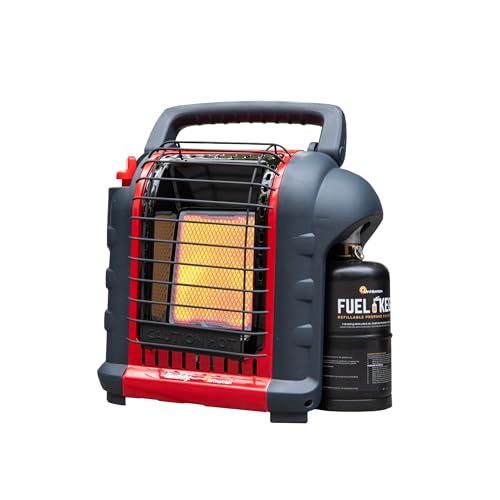
The Mr. Heater Portable Buddy is the most recognizable garage heater in America for good reason. It is the go-to solution for anyone who needs fast, portable heat without running a gas line or extension cord. Clip on a 1 lb propane cylinder and you have immediate radiant warmth in under a minute.
At 9,000 BTU on high, it is not designed to heat an entire 2-car garage in sub-zero temperatures. What it excels at is taking the chill off a small workshop, warming a specific work zone, or serving as a backup heater when power goes out. On low (4,000 BTU), a 1 lb cylinder lasts about 3 hours; on high, closer to 1.5 hours. A hose adapter for a standard 20 lb tank eliminates the cylinder cost issue for longer sessions.
Safety Features
The Portable Buddy includes an oxygen depletion sensor (ODS) that shuts the unit off if oxygen levels drop below safe limits, a critical feature for enclosed spaces. It also shuts off automatically if tipped over. These features make it one of the few propane heaters genuinely rated for indoor and semi-enclosed use by the manufacturer.
Pros
- Completely portable, no installation
- Works with 1 lb cylinders or 20 lb tanks
- ODS and tip-over safety shutoff
- Instant heat with piezo ignition
- Extremely affordable
Cons
- 9,000 BTU limits coverage area
- 1 lb cylinders become expensive for regular use
- No thermostat control

The Dr Infrared DR-988 earns its spot as the best electric garage heater by combining serious output with thoughtful design. Running on 240V at 5,600 watts, it puts out about 19,100 BTU, enough for a well-insulated 1-2 car garage. Dr. Infrared lists a thermostat adjustable from 37 to 113°F, a fan switch with ON and AUTO modes, and brackets to use it on the floor or mount it on a wall or ceiling.
What separates the DR-988 from cheaper electric shop heaters is the build quality. The heavy-duty steel housing handles workshop abuse. The adjustable thermostat means you set it and forget it, unlike propane heaters that require manual adjustment. The built-in carry handle makes repositioning easy, though most users mount it permanently on a wall or ceiling bracket.
Installation Requirements
The DR-988 ships with a 6-foot cord and a NEMA 6-30P plug, so it needs a dedicated 250V/30-amp NEMA 6-30R outlet. If your garage already has 240V service, installation is straightforward. If not, budget $150-$400 for an electrician to run the circuit. This is the primary barrier for most buyers, but once installed you have clean, thermostat-controlled heat with zero fuel costs beyond your electricity bill.
Pros
- No fuel to buy or store
- Adjustable thermostat for set-and-forget convenience
- Heavy-duty construction built for shop environments
- No combustion byproducts, safe in sealed spaces
- Consistent heat output
Cons
- Requires dedicated 240V circuit
- Electric heat is more expensive per BTU than gas
- Won't work during power outages

RMC-FA60DGD 30,000-60,000 BTU Heater
The Dyna-Glo Delux RMC-FA60DGD occupies the sweet spot between the convenience of a portable heater and the output of a mid-range unit. Dyna-Glo lists continuously variable output from 30,000 to 60,000 BTU and heating up to 1,350 square feet, so you can dial it down once the space is warm rather than running at full blast.
It runs on standard 20 lb propane tanks and includes a 10-foot hose and regulator, continuous electronic ignition to prevent delayed ignition, an adjustable heat angle and overheat auto shutoff. The fan-forced output distributes heat much more evenly than a radiant heater of the same BTU rating, making it a better choice when you need the whole garage warm rather than just one work zone.
Best Use Case
The Dyna-Glo Delux shines for seasonal users who heat their garage a few months per year. There is no permanent installation, no gas line, and no 240V requirement. Bring it out when it turns cold and store it for the warm season. At its price point it delivers reliable performance for the budget-conscious shop owner who heats the space for a few hours at a time.
Pros
- Portable and easy to store
- Variable heat output control
- Uses standard 20 lb propane tanks
- Overheat auto shutoff and continuous ignition
- Affordable entry price
Cons
- Requires ventilation (not indoor-rated like Buddy)
- Ongoing propane fuel cost
- No thermostat, manual operation only
Medium Garages: 30,000–60,000 BTU
Best for 2-3 car garages and shops from 600–1,200 sq ft. Also covers large well-insulated single spaces.

The Mr. Heater 30,000-60,000 BTU is the best overall garage heater for most shop owners. Mr. Heater lists output from 30,000 to 60,000 BTU per hour, heating up to 1,500 square feet, and up to 12 hours of run time, which covers a 2-3 car garage or a large workshop. Run it high to bring a cold shop up to temperature, then turn it down to cruise.
Continuous ignition keeps the burner lit reliably, and it needs a 20 lb propane tank at minimum; a 100 lb tank gives much longer sessions between refills. As with any forced air propane heater, it needs fresh-air ventilation and clearance from combustibles.
Why It Wins the Overall Category
The 30,000-60,000 BTU Forced Air threads the needle between output, portability, and price better than any other heater in this category. You get enough BTU for a large space, quiet operation that won't drown out conversation or music, and a brand (Mr. Heater / Enerco) with a strong track record in garage heating. The high/low heat control is a genuinely useful feature that lesser heaters skip.
Pros
- 60,000 BTU heats most 2-3 car garages
- Notably quieter than competing forced air heaters
- High/low heat settings for efficiency
- Continuous ignition, no relighting
- Portable or semi-permanent use
Cons
- Requires adequate ventilation
- No thermostat (manual high/low only)
- Propane tanks not included
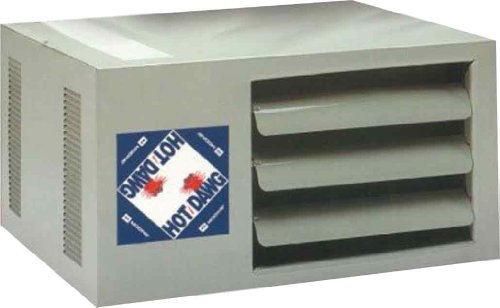
The Modine Hot Dawg is the gold standard for permanently installed garage unit heaters. HVAC professionals and serious shop owners have been specifying it for decades, and the HD45AS earns that reputation with quality construction, reliable operation, and features you won't find on cheaper units. The 45,000 BTU output with 80% efficiency delivers 36,000 BTU of actual usable heat, more than enough for a well-insulated 2-car garage.
The aluminized steel heat exchanger is the heart of the Hot Dawg's durability story. It resists corrosion from both combustion byproducts and garage humidity far longer than plain steel or stainless alternatives. The power vented exhaust allows flexible installation, you can vent horizontally through a wall without a dedicated vertical flue, which dramatically simplifies the installation in most garages.
Professional-Grade Features
The separated combustion option (on certain models) draws combustion air from outside rather than from the garage, which improves efficiency and is required in some airtight new construction installations. The factory-installed gas valve and controls are commercial-grade components designed to last 20+ years with minimal maintenance. This is a heater you install once and forget about.
Pros
- Lowest long-term operating cost (natural gas)
- Thermostat control for automatic operation
- Aluminized steel heat exchanger built to last
- Power vented, flexible horizontal installation
- Clean ceiling-mount keeps floor space clear
Cons
- Requires natural gas line and professional installation
- Highest upfront cost of any heater in this guide
- Not portable, permanent commitment
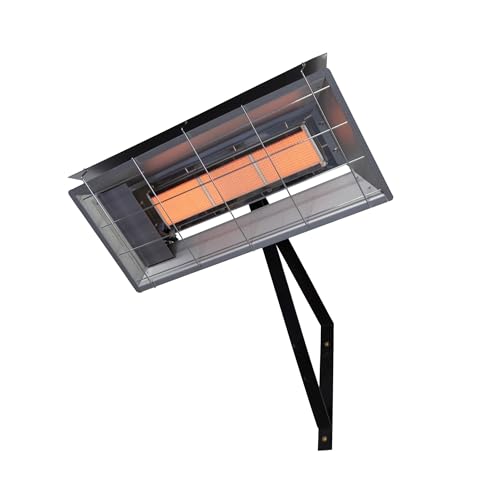
The Mr. Heater MH25LP takes a fundamentally different approach to garage heating: instead of heating the air, it heats the objects and people in the space using high-intensity radiant infrared heat. The result is a warm, comfortable feeling even in a drafty garage where forced air heat would quickly escape through gaps and door cracks.
Overhead mounting keeps the heater out of the way entirely, no floor space consumed, no tripping hazard, and no obstructions in your work area. Because radiant heat does not rely on warming a room's air volume, it is particularly effective in high-ceiling shops where stratification steals BTU efficiency from conventional heaters. You feel warm because the radiant energy is absorbed directly by surfaces and bodies, not because the ambient air temperature is high.
Efficiency Advantage
In a shop you only heat a few hours per week, radiant heat delivers more comfort per BTU consumed than forced air, because you are not wasting energy heating the full air volume of a large space. Mr. Heater rates it at up to 550 square feet, roughly a 2-1/2 car garage, and it ships fully assembled and CSA certified with a 1-year limited warranty. It costs more than a portable forced air heater of similar output, so it makes the most sense where silent, out-of-the-way heat is the priority.
Pros
- Comfortable warmth even in drafty spaces
- No blower, completely silent operation
- Overhead mount clears all floor and wall space
- Efficient for spot heating or high-ceiling shops
- CSA certified, ships fully assembled
Cons
- Requires professional installation and gas line
- Slower to heat an entire space vs forced air
- Heat concentrated in mounting footprint
Large Garages & Commercial Shops: 60,000+ BTU
For 3+ car garages, pole barns, and commercial workshops over 1,200 sq ft, or any uninsulated or poorly insulated large space.

When a 60,000 BTU heater is not enough, the Mr. Heater F271390 steps in with 125,000 BTU of propane forced air output capable of heating up to 3,125 square feet. This is the right tool for a large 3-4 car garage, a pole barn workshop, or any space where you need serious BTU without the complexity of a permanent gas line installation.
Like its smaller sibling the 30,000-60,000 BTU Forced Air, this unit features Quiet Burn Technology, which matters a lot at this BTU level where competing units can be painfully loud. Variable heat control lets you step down the output once you've brought the space up to temperature, saving propane and reducing noise. The unit is designed to run on a 100 lb or larger propane tank for all-day sessions.
Practical Considerations for Big Spaces
At 125,000 BTU, this heater consumes propane quickly, roughly 2.8 lbs per hour at full output. A 100 lb tank gives you about 35 hours of runtime. For heavy use, connecting to a permanently installed 250-gallon or 500-gallon propane tank via a regulated regulator hose makes more economic sense than hauling cylinders. The unit itself is portable enough to use on a job site or lend to a friend.
Pros
- 125,000 BTU handles even large poorly insulated shops
- Quiet operation for its output class
- Variable heat control for efficiency
- Portable, no permanent installation
- Heats up to 3,125 sq ft per manufacturer
Cons
- High propane consumption at full output
- Requires adequate ventilation in enclosed spaces
- No thermostat control

The Modine Hot Dawg 125,000 BTU unit is the flagship of the Hot Dawg line and arguably the best permanently installed shop heater available to consumers. At 125,000 BTU with 80% efficiency, it delivers about 100,000 BTU of usable heat, enough for a large 3-4 car garage, a serious woodworking or automotive shop, or a small commercial space.
The aluminized steel heat exchanger is built for the long haul: it reflects the genuine quality of the Hot Dawg construction. Power exhaust venting gives you installation flexibility to run horizontally through a wall, and the heavy-gauge steel cabinet stands up to decades of shop conditions without rust or degradation. This is a commercial-grade product at a consumer-accessible price.
Total Cost of Ownership
Natural gas costs roughly one-third to one-half as much as propane per BTU in most US markets. For a shop owner who heats 5-6 months per year, the fuel savings of this Hot Dawg vs a comparable propane unit can pay back the installation cost in 3-5 years. Over the 20+ year service life of the unit, the economics are compelling for any shop used regularly.
Pros
- Lowest per-BTU operating cost (natural gas)
- Durable aluminized steel heat exchanger
- Commercial-grade construction
- Power vented for flexible installation
- Thermostat control for automatic operation
Cons
- Requires natural gas line and professional installation
- Significant upfront cost with installation
- Not an option without utility gas service
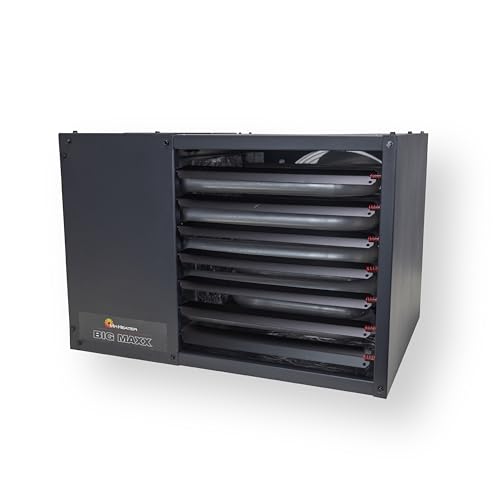
Big Maxx MHU80NG 80,000 BTU
The Mr. Heater Big Maxx MHU80NG is the value alternative to a Modine for a permanently installed natural gas unit heater. At 80,000 BTU it heats a large 3-car garage or a serious shop, and the ceiling-mount design keeps your floor and walls completely clear. It is the most affordable way into a thermostat-controlled, hardwired gas heater that runs all winter without hauling propane cylinders.
Mr. Heater lists it at 80,000 BTU heating up to 2,667 square feet, in propane or natural gas versions, with a high-temperature safety shutoff and a flame sensor that shuts off gas if the flame goes out. It works with a standard 24-volt thermostat (sold separately). It needs at least a 10 foot ceiling with 8 feet of clearance from the base of the heater to the floor.
Ideal Placement
Mount it in a high corner angled across the shop and the fan-forced output covers a large open area evenly. It pairs well with a low-voltage thermostat for hands-off operation and is a popular pick for woodworking and automotive garages that need reliable heat at a price well below the Modine Hot Dawg.
Pros
- Most affordable natural gas unit heater here
- 80,000 BTU covers large 3-car shops
- Ceiling mount frees up floor and wall space
- Power vented for flexible horizontal venting
- Thermostat compatible for set-and-forget heat
Cons
- Requires natural gas line and professional installation
- Needs adequate ceiling clearance
- Propane conversion kit sold separately

The Mr. Heater 170,000 BTU Quiet Burner forced air heater is the serious contractor-grade solution for large commercial spaces and extra-large shops. At 170,000 BTU with an included thermostat, it can maintain comfortable working temperatures in spaces up to 4,250 square feet, a pole barn, large auto body shop, or commercial warehouse floor. The thermostat inclusion at this price point is notable; most high-output propane heaters require a separate purchase.
The Quiet Burner Technology is a meaningful upgrade over older open-flame competitors, cutting the jet-engine roar that makes most high-output propane heaters hard to work near. The powerful blower moves a lot of air, so keep loose dust and wood shavings clear of the intake. This matters most in woodworking and fabrication shops.
Commercial vs Home Use
At 170,000 BTU, this heater is more than most home garages need. It is the right choice for contractors who heat job site structures, farmers with large equipment sheds, and small business owners with commercial workshop space. Mr. Heater (an Enerco brand) has a strong reputation for durability in demanding conditions.
Pros
- 170,000 BTU for the largest spaces
- Thermostat included
- Enclosed flame design for shop safety
- Handles up to 4,250 sq ft
- Commercial-grade build quality
Cons
- Overkill for typical home garages
- Very high propane consumption at full output
- Requires large propane tank for practical use
BTU Sizing Guide for Garage Heaters
Getting the right BTU for your space is the single most important decision in this purchase. Too small and your heater runs constantly and struggles to keep up. Too large and you waste money upfront and burn through fuel faster than necessary.
The 30-50 BTU Per Square Foot Rule
The foundational rule for shop heater sizing is 30-50 BTU per square foot. Use 30 BTU/sq ft for well-insulated spaces in mild climates. Use 50 BTU/sq ft for poorly insulated garages in cold climates. Most garages fall around 40-45 BTU/sq ft as a working estimate.
| Garage Size | Square Footage | Moderate Climate (40 BTU/sq ft) | Cold Climate (50 BTU/sq ft) | Recommended Heater |
|---|---|---|---|---|
| 1-Car Garage | 250-300 sq ft | 10,000-12,000 BTU | 12,500-15,000 BTU | Portable Buddy or DR-988 |
| 2-Car Garage | 400-500 sq ft | 16,000-20,000 BTU | 20,000-25,000 BTU | DR-988 or Dyna-Glo 30-60K |
| Large 2-Car Garage | 500-600 sq ft | 20,000-24,000 BTU | 25,000-30,000 BTU | 30,000-60,000 BTU Forced Air (low) or Dyna-Glo |
| 3-Car Garage | 650-900 sq ft | 26,000-36,000 BTU | 32,500-45,000 BTU | 30,000-60,000 BTU Forced Air or Hot Dawg 45K |
| Large Shop / 4-Car | 1,000-1,200 sq ft | 40,000-48,000 BTU | 50,000-60,000 BTU | 30,000-60,000 BTU Forced Air high or Big Maxx 80K |
| Pole Barn / Large Shop | 1,500-2,500 sq ft | 60,000-100,000 BTU | 75,000-125,000 BTU | Mr. Heater 125K or Hot Dawg 125K |
| Commercial / Large Barn | 2,500-4,000 sq ft | 100,000-160,000 BTU | 125,000-200,000 BTU | Mr. Heater 170K or multiple units |
How Insulation Changes the Equation
Insulation has a dramatic effect on BTU requirements. A well-insulated garage with R-13 walls, R-30 ceiling, and insulated garage door can need 40-50% fewer BTU than an uninsulated slab-on-grade structure with a bare metal door. Before sizing a heater, consider whether adding insulation is cost-effective: adding $500-$1,000 in insulation may allow you to buy a smaller, cheaper heater and pay less in fuel every year. Our workshop heating and cooling guide covers insulation, ventilation, and year-round climate control in depth.
Uninsulated Garage
Add 20-30% to your base BTU calculation.
- Bare concrete or block walls
- Uninsulated metal or wood ceiling
- Standard un-insulated garage door
- Significant air infiltration
Partially Insulated
Use the base 40 BTU/sq ft calculation.
- R-13 fiberglass batt walls
- Basic ceiling insulation
- Standard un-insulated garage door
- Average air sealing
Well Insulated
Can reduce to 30 BTU/sq ft or less.
- R-19 or better walls
- R-30+ ceiling insulation
- Insulated garage door (R-8 or better)
- Weatherstripped doors and windows
Ceiling Height Adjustments
Standard BTU calculations assume an 8-foot ceiling. Every foot of additional ceiling height increases your BTU requirement by approximately 10%. A 20x25 ft garage (500 sq ft) with a 10-foot ceiling needs about 20% more BTU than the same floor plan with an 8-foot ceiling.
- 8 ft ceiling: Use base BTU calculation
- 9 ft ceiling: Add 10% to base BTU
- 10 ft ceiling: Add 20% to base BTU
- 12 ft ceiling: Add 40% to base BTU
- 14+ ft ceiling: Add 60%+ and consider overhead radiant heat
Pro Tip: Add a 25% Safety Margin
Size up your heater by 25% beyond your calculated BTU need. This accounts for doors being opened frequently, periods of extreme cold, and ensures the heater is not running at 100% capacity continuously, which extends its service life and keeps temperatures more stable during warm-up periods.
Calculate Your Exact BTU Requirement
Our Shop Heater BTU Calculator accounts for your garage dimensions, insulation rating, ceiling height, and climate zone. Get a precise recommendation in under a minute.
Fuel Type Comparison: Propane vs Natural Gas vs Electric
Choosing the right fuel type is as important as choosing the right BTU. Each fuel source has distinct advantages that make it the clear winner in certain situations.
Propane (LP Gas)
The most flexible choice for most homeowners.
- No gas line required, portable
- High BTU output available
- Works in power outages
- Higher fuel cost than natural gas
- Requires propane tank management
- Best for: detached garages, seasonal use, portability
Natural Gas
Best long-term economics for attached or connected garages.
- Lowest per-BTU fuel cost
- Never runs out, utility supply
- Thermostat control with permanent install
- Requires gas line installation
- Not portable
- Best for: year-round shop use, attached garages
Electric
Easiest installation, highest operating cost per BTU.
- No combustion, safe in sealed spaces
- Precise thermostat control
- Requires 240V circuit for serious output
- Highest per-BTU cost to run
- No fuel to store or order
- Best for: small shops, attached garages, mild climates
Operating Cost Comparison
At average 2026 US energy prices, here is approximately what it costs to produce 100,000 BTU of heat from each fuel source:
| Fuel Type | Price per Unit (2026 avg) | BTU per Unit | Cost per 100,000 BTU | Heater Efficiency |
|---|---|---|---|---|
| Natural Gas | $1.40/therm | 100,000 BTU/therm | ~$1.75 | 78-80% |
| Propane | $3.00/gallon | 91,500 BTU/gallon | ~$4.00 | 90-100% |
| Electric (240V) | $0.16/kWh | 3,412 BTU/kWh | ~$4.70 | 100% |
Natural gas wins on operating cost by a significant margin when it is available. Propane and electric are comparable in cost per BTU delivered, though propane has the advantage of working without electrical service. These figures vary significantly by region, check your local utility rates for accurate comparisons.
Garage Heater Safety: What Every Shop Owner Needs to Know
Heating equipment is involved in a significant portion of home fires and carbon monoxide incidents. Understanding and following basic safety practices eliminates the vast majority of this risk.
Carbon Monoxide Awareness
All combustion heaters (propane, natural gas) produce carbon monoxide (CO) as a byproduct. In a well-ventilated space, CO dissipates safely. In a sealed or poorly ventilated garage, it can reach dangerous concentrations quickly.
- Install a carbon monoxide detector in any garage where combustion heaters are used
- Keep a window or door cracked when running propane or natural gas heaters
- Never run a vehicle, generator, or combustion tool in a closed garage simultaneously with a heater
- Permanently installed unit heaters with power venting dramatically reduce indoor CO risk
Clearance Requirements
All garage heaters require minimum clearances from combustibles. Check your specific unit's manual, but general guidelines are:
- Forced air heaters: Minimum 18-24 inches from combustibles at the exhaust end; 6-12 inches on sides
- Radiant heaters: Manufacturer-specified overhead clearance from combustibles (often 36-48 inches)
- Unit heaters: Minimum clearances specified on the unit nameplate, always follow these
- Never position a heater so that exhaust or radiant heat faces stored flammable materials, paper, wood, or fabric
Propane Storage and Connection
Propane tanks must be stored outdoors, never in a garage, basement, or enclosed structure. When connecting a hose to a portable heater, inspect the hose for cracks or damage before each use. Use a leak detection solution (or diluted dish soap) to check connections after assembly. Always turn off the tank valve when the heater is not in use.
Fire Extinguisher Requirement
Any garage with a combustion heater should have a minimum 2.5 lb ABC dry chemical fire extinguisher mounted near the exit, not next to the heater. In a fire scenario you need to reach the extinguisher before reaching the fire. Check the gauge monthly and service every 6 years or after any use.
Frequently Asked Questions
For most garages, the best heater is the Mr. Heater 30,000-60,000 BTU propane forced air heater: no installation, adjustable output, and rated for up to 1,500 square feet for under $250. If you have 240V power and want thermostat control with no fuel, choose the Dr. Infrared DR-988. If you have a gas line and heat the shop all winter, a permanently installed Modine Hot Dawg unit heater is the most economical to run.
The Dr. Infrared DR-988 is our pick: 5,600 watts (about 19,100 BTU) on 240V, a 37 to 113°F thermostat, ON and AUTO fan modes, and floor, wall or ceiling mounting. It needs a dedicated 30-amp NEMA 6-30R outlet. A 120V plug-in heater tops out at 1,500 watts (about 5,100 BTU), which only warms a small area of a garage.
For portable use, the Mr. Heater 30,000-60,000 BTU forced air heater is the best balance of output and price. For a big or poorly insulated space, step up to the Mr. Heater 125,000 BTU. For a small area or occasional use, the Mr. Heater Portable Buddy is rated for indoor use with a low-oxygen shutoff and tip-over switch. For permanent propane heat, a vented ceiling unit heater like the Mr. Heater Big Maxx is safer than running a portable unit for hours.
It can be, with precautions. Portable forced air propane heaters are not vented, so they release combustion gases, including carbon monoxide, into the garage. Follow the manufacturer's ventilation requirement (usually an opening to fresh air), run a CO alarm, keep the heater away from gasoline, solvents and sawdust, and never sleep in a space heated this way. For daily heat, a vented unit heater installed by a licensed professional is the safer choice.
A general rule is 30-50 BTU per square foot for a well-insulated garage. Multiply your square footage by 45 BTU for average insulation. A 1-car garage (250-300 sq ft) needs roughly 12,000-15,000 BTU. A 2-car garage (500-600 sq ft) needs 22,500-30,000 BTU. A 3-car garage (750-900 sq ft) needs 34,000-45,000 BTU. Use our Shop Heater BTU Calculator for a precise recommendation based on your specific dimensions, insulation, and climate.
Propane forced air heaters offer the best portability and high BTU output at a reasonable price, ideal for detached garages without gas lines. Natural gas unit heaters (like the Modine Hot Dawg) are the most economical to operate long-term if you already have a gas line. Electric heaters are the easiest to install but cost the most to run and are best suited for small shops or supplemental heat. For large uninsulated garages, propane or natural gas forced air is the most practical choice.
Yes, with proper precautions. Propane heaters designed for indoor or semi-enclosed use (like the Mr. Heater Portable Buddy) include an oxygen depletion sensor (ODS) and tip-over shutoff. Always ensure adequate ventilation, crack a window or door to maintain fresh air. Forced air propane heaters like the 30,000-60,000 BTU Forced Air are designed for garage use with proper ventilation. Never use a construction-style propane salamander heater in a completely sealed space. Install a carbon monoxide detector in any garage where combustion heaters are used.
Forced air heaters use a blower to push heated air throughout the space, warming the air quickly and evenly, best for whole-garage heating. Radiant heaters (infrared) heat objects and people directly without warming the surrounding air, which makes them efficient for heating specific work zones without wasting energy on unused space. Radiant heaters are also quieter since they have no blower. For a complete garage warm-up, forced air heats faster. For a specific work area or a drafty space, radiant is often more efficient and comfortable.
Portable propane forced air heaters are the right choice if you use the garage seasonally, rent your space, or do not want to invest in permanent gas line installation. Permanently installed unit heaters (natural gas or propane) like the Modine Hot Dawg are better if you use the garage regularly year-round, want set-and-forget thermostat control, and have access to a gas line. Permanent units are cleaner, quieter, and cheaper to operate over time but require professional installation costing $1,095-$2,000 depending on complexity.
Yes, significantly. Standard BTU calculations assume an 8-foot ceiling. For every foot above 8 feet, add approximately 10% to your BTU requirement. A 2-car garage with 12-foot ceilings needs roughly 40% more BTU than the same footprint with standard ceilings. High bay shops with 14-foot or taller ceilings often benefit from overhead radiant heat, which warms objects and people directly rather than fighting against rising heat stratification. Use our BTU Calculator to factor ceiling height into your sizing.
For occasional use with a 30,000-60,000 BTU heater, a standard 20 lb (5 gallon) propane tank works fine. A 60,000 BTU heater on high burns roughly 1.4 lbs of propane per hour, meaning a 20 lb tank lasts about 14 hours. For regular use or high-output heaters (100,000+ BTU), a 100 lb tank or permanently plumbed 250-gallon tank is more practical. Keep a spare tank on hand, propane flow can be restricted in very cold temperatures as the cylinder pressure drops.
As an Amazon Associate, WorkshopCalc earns from qualifying purchases. This does not affect our editorial independence. We recommend products based on manufacturer specifications and verified owner reviews, regardless of affiliate relationships.
Safety note: This guide is researched general information, not professional advice. Fuel-burning heaters produce carbon monoxide: provide the ventilation the manufacturer requires, run a CO alarm, keep clearances to combustibles, and follow the manual and your local code. Natural gas and propane unit heaters and new 240V circuits should be installed by a licensed professional.