Best Welder 2026: 9 MIG, TIG & Stick Picks by Brand
The right welder opens up fabrication possibilities that no other tool can match, from repairing farm equipment to building custom furniture frames and race car chassis. This guide reviews the nine best welders of 2026 across every process and budget, so whether you are striking your first arc or upgrading a serious production shop, you will find the right machine here.
The best welder for most home shops is the Lincoln Electric POWER MIG 215 MPi: a 20 to 215 amp multi-process machine that runs on 120V or 240V and does MIG, flux-core, TIG and stick. On a tighter budget the Hobart Handler 140EZ (120V, MIG and flux-core) is the best beginner welder, and the Miller Multimatic 220 AC/DC is the pick when you also weld aluminum. Updated 2026.
Best brand of welder: Lincoln, Miller, Hobart, ESAB, Everlast, YesWelder
There is no single best brand of welder; the right brand is the one that makes the process you need at the amperage you need. The table maps each brand in this guide to the machine we reviewed and what it is best for, so you can shop by brand and still land on the right process. Amp ranges and duty cycles are manufacturer specifications from the comparison table below.
| Brand | Model in this guide | Process | Amps | Best for |
|---|---|---|---|---|
| Lincoln Electric | POWER MIG 215 MPi | MIG / TIG / Stick / Flux-Core | 20-215A | Best all-round home shop machine |
| Miller | Multimatic 220 AC/DC | MIG / AC TIG / DC TIG / Stick | 20-220A | Aluminum and steel in one unit |
| Miller | Millermatic 252 | MIG / Flux-Core | 30-300A | Production MIG on 230V |
| Hobart | Handler 140EZ | MIG / Flux-Core | 25-130A | Beginners on 115V household power |
| ESAB | Rebel EMP 235ic | MIG / Flux-Core / TIG / Stick | 5-235A | Portable multi-process with a wide amp range |
| Everlast | PowerTIG 255EXT | AC TIG / DC TIG / Stick | 5-255A | TIG value, including aluminum |
| YesWelder | MIG-205DS PRO | MIG / Flux-Core / Stick / Lift TIG | 20-205A | Budget multi-process |
How to choose between them: start with the metal you weld. Steel up to about 1/4 inch is comfortable on any of the MIG machines above; aluminum needs a spool gun for MIG or an AC TIG machine like the Multimatic or PowerTIG. Then check the power you have. A 120V circuit limits you to the smaller machines, and 240V opens the thicker-steel range. Duty cycle matters for long welds: it is the share of a ten-minute period the machine can run at a given amperage. See the buying guide below for each factor, and our welding shop setup guide for ventilation, power and safety.
Quick Picks: Our Top Recommendations
After researching welding machines for home shops, garages, and production environments, these are our top picks for 2026:
Prices change on Amazon. Amounts shown are planning estimates, not live quotes. Tap any button for current pricing.
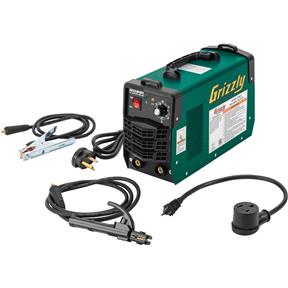
Grizzly sells its own welders direct, which keeps the price below the name brands for the same amperage class:
- Grizzly G0881 180A Stick Welder is the highest-rated unit in their line (4.9 stars). A compact inverter stick welder for repairs, farm work and thick steel.
- Grizzly G0882 200A MIG Welder handles gas or flux-core wire for shop fabrication and auto body work at a mid-tier price.
Product Comparison Table
Compare key specifications across all nine welders at a glance:
| Model | Process | Amp Range | Duty Cycle | Input Voltage | Wire Feed Speed | Budget |
|---|---|---|---|---|---|---|
| Lincoln Electric POWER MIG 215 MPi | MIG / TIG / Stick / Flux-Core | 20-215A | 40% @ 200A | 120V / 240V | 50-500 IPM | Under $2,500 |
| Miller Multimatic 220 AC/DC | MIG / AC TIG / DC TIG / Stick | 20-220A | 40% @ 220A | 120V / 240V | 50-700 IPM | $2,500+ |
| Hobart Handler 140EZ MIG Welder | MIG / Flux-Core | 25-130A | 25% @ 90A | 115V | 40-700 IPM | Under $1,000 |
| TOMAHAWK 15 HP Engine-Driven Welder | Stick / TIG / Generator | Up to 210A | 60% @ 210A | Engine-driven (15 HP gas) | N/A (stick/TIG) | Under $2,500 |
| Everlast PowerTIG 255EXT | AC TIG / DC TIG / Stick | 5-255A | 60% @ 255A | 120V / 240V | N/A (TIG/Stick) | Under $2,500 |
| Miller Millermatic 252 | MIG / Flux-Core | 30-300A | 60% @ 300A | 208V / 230V | 50-700 IPM | $2,500+ |
| YESWELDER MIG-205DS PRO | MIG / Flux-Core / Stick / Lift TIG | 20-205A | 60% @ 200A | 110V / 220V | 50-500 IPM | Under $1,000 |
| ESAB Rebel EMP 235ic | MIG / Flux-Core / TIG / Stick | 5-235A | 50% @ 235A | 120V / 230V | 50-700 IPM | $2,500+ |
| Titanium Stick 225 Inverter Welder | Stick (SMAW) | 10-225A | 30% @ 160A | 120V / 240V | N/A (Stick) | Under $500 |
Detailed Reviews

Lincoln Electric POWER MIG 215 MPi
Multi-ProcessThe Lincoln Electric POWER MIG 215 MPi is our top pick for home shop welders who want one machine that does everything. Multi-voltage input, excellent arc quality across all processes, and Lincoln's industry-leading reliability make this the benchmark multi-process welder for the serious home shop.
Pros
- Multi-voltage input (120V and 240V) on one machine
- Welds MIG, TIG, stick, and flux-core from a single unit
- Lincoln Electric build quality and reliability
- Synergic MIG mode suggests settings based on wire and material
- Color TFT display makes setup intuitive
Cons
- TIG torch and foot pedal sold separately
- Spool gun for aluminum is an extra-cost add-on
- Slightly heavier than comparable inverter machines
Our Verdict
The Lincoln POWER MIG 215 MPi is the best all-around welder for home shop use. It handles virtually every welding task you will encounter and grows with your skill level, from sheet metal to 3/8-inch steel fabrication.

Miller Multimatic 220 AC/DC
Premium Multi-ProcessThe Miller Multimatic 220 AC/DC is the premium multi-process welder that professional fabricators choose when they need AC TIG capability, required for aluminum welding, in a portable, multi-voltage package. No other machine in its class matches the arc quality and build.
Pros
- AC TIG capability for aluminum welding
- Auto-Set Elite technology simplifies MIG setup
- Best-in-class arc quality for all processes
- Multi-voltage input for jobsite and shop use
- Miller's legendary reliability and domestic service network
Cons
- Significant price premium over competitors
- TIG accessories add to total cost
- Overkill for welders who do not need AC TIG
Our Verdict
The Miller Multimatic 220 is the right machine for serious fabricators who TIG weld aluminum regularly and want the best build quality money can buy. For welders who do not weld aluminum, the Lincoln POWER MIG 215 MPi offers similar capability at a lower price.

Hobart Handler 140EZ MIG Welder
MIG WelderThe Hobart Handler 140EZ is the best plug-and-play MIG welder for home shops and garages running on standard household power. It runs gas or flux-core wire, plugs into any 115V outlet, and delivers the clean wire feed and reliable arc Hobart is known for, making it an ideal first MIG machine for thinner steel and general repair.
Pros
- Runs on a standard 115V household outlet
- Excellent wire feed consistency for smooth arcs
- Handles gas MIG and self-shielded flux-core wire
- Hobart reliability backed by Illinois Tool Works manufacturing
- Includes MIG gun, ground clamp, and accessories
Cons
- No 240V option limits output to lighter material
- No TIG capability, dedicated MIG only
- Lower duty cycle than 240V machines
Our Verdict
If MIG welding is your primary process and you want a dependable machine that runs on household power, the Hobart Handler 140EZ is the answer. The clean arc and reliable wire feed make it a true workhorse for sheet metal and lighter fabrication.
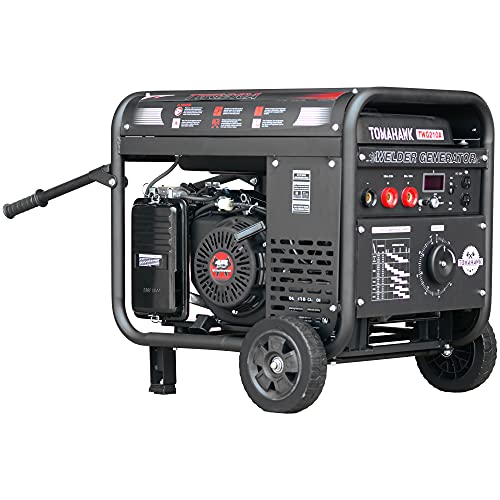
TOMAHAWK 15 HP Engine-Driven Welder
Engine DriveThe TOMAHAWK 15 HP engine-driven welder generator is the field-work pick in this lineup. It pairs 210 amps of stick and TIG output at a 60 percent duty cycle with 2,000 watts of inverter generator power, so it runs electric tools while you weld. The maker rates it for 1/8, 1/4, and 3/8 inch material, and amperage is set with an electronic readout and knob.
Pros
- 210A stick and TIG output without grid power
- 2,000W inverter generator runs tools and lights
- Stable sine-wave output for steady arcs
- 60% duty cycle at full output
- Costs far less than name-brand engine drives
Cons
- Heavy, plan for a truck bed or trailer
- Engine maintenance adds operational cost
- Smaller dealer network than Hobart or Miller
Our Verdict
The TOMAHAWK 15 HP is the best engine-driven welder value on Amazon for anyone who works in the field or needs a remote power source. Name-brand engine drives weld beautifully but cost twice as much and mostly sell through dealers.

Everlast PowerTIG 255EXT
AC/DC TIGThe Everlast PowerTIG 255EXT delivers AC/DC TIG and stick capability at a price point that significantly undercuts Miller and Lincoln equivalents. For hobbyists and small shops who want to TIG weld aluminum without an over-$2,500 machine, the PowerTIG 255EXT is the best value available.
Pros
- AC TIG for aluminum at significantly lower cost than American brands
- Pulse TIG capability for thin material and heat control
- 60% duty cycle handles long production runs
- Built-in high-frequency arc start, no scratch starting required
- Solid build quality for the price point
Cons
- Everlast support is less accessible than Lincoln or Miller
- Display and controls less polished than premium brands
- Best output requires a 240V circuit
Our Verdict
The Everlast PowerTIG 255EXT is the best TIG welder under $2,500 for home shop fabricators. It gives you the AC TIG aluminum capability of a Miller Dynasty at a fraction of the cost, with good enough reliability for regular hobby and light production use.

Miller Millermatic 252
Production MIGThe Miller Millermatic 252 is the production MIG welder for shops that run wire continuously. Its 60% duty cycle at full 300A output, Auto-Set technology, and 700 IPM wire feed speed make it the benchmark for small to mid-size fabrication shops running 8-hour shifts.
Pros
- 300A output handles up to 1/2-inch steel in a single pass
- 60% duty cycle at max output for sustained production welding
- Auto-Set Elite for fast parameter setup between jobs
- Industrial-grade wire drive mechanism for consistent feed
- Miller reliability with nationwide dealer service
Cons
- Requires 208V or 230V, no 120V compatibility
- Heavy machine designed for stationary shop use
- Overkill for occasional or hobby welding
Our Verdict
The Miller Millermatic 252 is the right welder for production shops that run MIG wire all day. If your shop regularly welds 1/4-inch and thicker steel in volume, this machine pays for itself in productivity and reliability.

YESWELDER MIG-205DS PRO
Budget Multi-ProcessThe YESWELDER MIG-205DS PRO is the best budget welder for beginners and occasional users who want 5-in-1 multi-process capability without a four-figure investment. Build quality does not match Lincoln or Miller, but the arc performance for the price is genuinely impressive, and it includes spool-gun support for aluminum.
Pros
- Multi-process capability at budget price
- Multi-voltage input on 110V or 220V
- Synergic MIG mode simplifies setup for beginners
- Digital display for easy parameter monitoring
- Good value for occasional and learning use
Cons
- Build quality and longevity behind premium brands
- Wire feed can be inconsistent at lower settings
- Limited dealer support, mostly self-service
- TIG quality does not match dedicated TIG machines
Our Verdict
The YESWELDER MIG-205DS PRO is the best budget welder under $500 and an excellent starting point for beginners. Expect to upgrade to a Lincoln or Miller once your welding volume justifies it, but this machine will teach you the fundamentals well.

ESAB Rebel EMP 235ic
Portable Multi-ProcessThe ESAB Rebel EMP 235ic is the best portable multi-process welder for professionals who move between jobsites and shops. Its sMIG technology monitors arc conditions in real time and adjusts wire feed for consistent results even as conditions change, a genuine innovation for field welding.
Pros
- sMIG technology adapts to changing conditions automatically
- Excellent portability at 40 lbs for a full-featured machine
- Multi-voltage for home, shop, and jobsite use
- Outstanding arc quality across all processes
- ESAB build quality and international support network
Cons
- Higher price than comparable Lincoln or Hobart alternatives
- TIG requires separately purchased torch and accessories
- sMIG technology has a short learning curve to trust
Our Verdict
The ESAB Rebel EMP 235ic is the best multi-process welder for contractors and professionals who need consistent results in varying field conditions. The sMIG technology is a real-world differentiator that reduces bad welds on difficult jobsite material.

Titanium Stick 225 Inverter Welder
Stick WelderThe Titanium Stick 225 is a capable inverter stick welder for home shop use. Inverter technology makes it a fraction of the weight of transformer-based machines while delivering smooth, forgiving arc starts and solid bead control for all common stick electrodes, and dual-voltage input adds flexibility.
Pros
- Lightweight inverter design, far lighter than transformer machines
- Strong arc quality with E6010, E6013, and E7018 rods
- Hot-start and arc-force reduce rod sticking on initiation
- Dual-voltage 120V/240V input for flexibility
- Includes electrode holder and work clamp
Cons
- Full 225A output needs a 240V circuit
- Low duty cycle at high amperage limits long runs
- No MIG capability, stick only
Our Verdict
The Titanium Stick 225 is the best stick welder for home shops and farms on a budget. Its light weight, clean arc, and reliable rod starts make it the first tool to grab for repair work on rusty or painted steel, cast iron, and structural steel.

Photo via Unsplash
Welder Buying Guide
Choosing the right welder requires matching the process to your materials, your experience level, and your shop's electrical capacity:
🔗 Planning a project? Estimate the steel with the metal weight calculator before you order or lift it.
Frequently Asked Questions
What is the best welder for a beginner?
For beginners, MIG welding is the easiest process to learn. The Lincoln Electric POWER MIG 215 MPi or Hobart Handler 140EZ are excellent starting points. Both weld mild steel and flux-core wire and offer enough capability to grow into as your skills develop.
What is the difference between MIG, TIG, and stick welding?
MIG (GMAW) uses a continuously fed wire electrode and shielding gas (fastest to learn, great for production work. TIG (GTAW) uses a non-consumable tungsten electrode and separate filler rod) slowest but most precise, required for thin aluminum and stainless. Stick (SMAW) uses a flux-coated electrode, most versatile for outdoor and dirty metal work, lowest equipment cost.
What voltage do I need for a home shop welder?
Most hobby and home shop welders run on 120V or 240V. 120V machines are convenient but limit output to around 90-100A, which restricts material thickness. 240V machines deliver full rated output and are required for serious fabrication work. Multi-voltage machines like the Lincoln POWER MIG 215 MPi accept both 120V and 240V.
How thick of metal can a home shop MIG welder handle?
A 200A MIG welder on 240V can weld up to 3/8-inch mild steel in a single pass with proper technique. For heavier material (1/2-inch and above), multi-pass welds or a higher-output machine like the Millermatic 252 is needed. Most home shop projects involve 1/8-inch to 1/4-inch material, well within range of a 210A welder.
Is it worth buying a multi-process welder?
Yes, for most home shop welders. A multi-process machine like the Lincoln POWER MIG 215 MPi gives you MIG, stick, and TIG capability in one unit, versus buying three separate machines. The tradeoff is that dedicated single-process machines often have better ergonomics for that specific process.
How much does a good home shop welder cost?
Budget $350-$500 for a capable entry-level MIG or stick welder, $900-$1,500 for a quality mid-range multi-process machine, and $2,500-$4,000 for a professional-grade welder from Lincoln, Miller, or ESAB. Engine-driven welders for remote work start around $3,000.
Related Calculators & Resources
Use these tools to plan your welding shop setup:
As an Amazon Associate, WorkshopCalc earns from qualifying purchases. Our recommendations are based on research into specifications, pricing, and verified owner reviews, not hands-on testing. We only recommend products we believe provide genuine value to welders and fabricators.