Thread Pitch Chart

Photo via Unsplash
Complete reference for inch (UNC & UNF) and metric thread pitch, threads-per-inch (TPI), thread series, and major diameters. Identify any bolt, nut, or tapped hole.
Photo via Unsplash
Complete reference for inch (UNC & UNF) and metric thread pitch, threads-per-inch (TPI), thread series, and major diameters. Identify any bolt, nut, or tapped hole.
As an Amazon Associate, we earn from qualifying purchases. See all recommendations
Whether you're matching a replacement bolt, setting up a tap, or identifying a mystery fastener, knowing the thread pitch is essential. This chart covers the two inch thread series, UNC (coarse) and UNF (fine), with threads-per-inch (TPI) and major diameters, plus the full metric range with coarse and fine pitch in millimeters. Use it alongside our tap drill chart to drill and tap threads accurately.
Thread pitch describes how fine or coarse a thread is. Inch threads use TPI (threads per inch) in two series, UNC (coarse) and UNF (fine); e.g. 1/4" comes as 1/4-20 (UNC) or 1/4-28 (UNF), and 1/2" as 1/2-13 or 1/2-20. Metric threads use pitch in mm (distance between threads); e.g. M6 coarse = 1.0mm, M8 = 1.25mm, M10 = 1.5mm, M12 = 1.75mm. Coarse threads are stronger/faster and more damage-tolerant; fine threads resist vibration and adjust more precisely. See the full UNC/UNF and metric charts below.
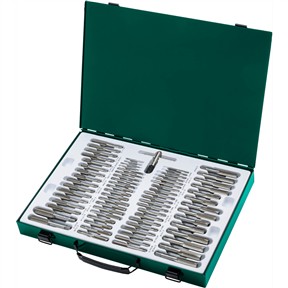
A ratcheting tap and die set lets you cut or chase any inch or metric thread in the tables below.
 Better Pick
GEARWRENCH 114-Piece Ratcheting Tap and Die Set (82812)
SAE + metric, ratcheting T-wrench handles
Under $500
Check Price on Amazon
Better Pick
GEARWRENCH 114-Piece Ratcheting Tap and Die Set (82812)
SAE + metric, ratcheting T-wrench handles
Under $500
Check Price on Amazon
 Pro Pick
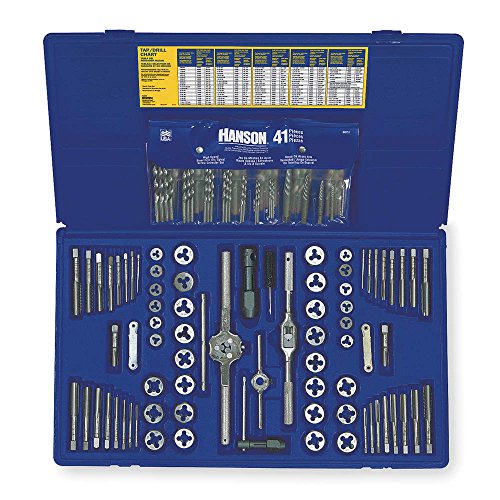
IRWIN Hanson 117-Piece Tap, Die and Drill Bit Set (26377)
Taps, hex dies and matching drill bits
Under $1,000
Check Price on Amazon
Pro Pick
IRWIN Hanson 117-Piece Tap, Die and Drill Bit Set (26377)
Taps, hex dies and matching drill bits
Under $1,000
Check Price on Amazon
 Budget Pick
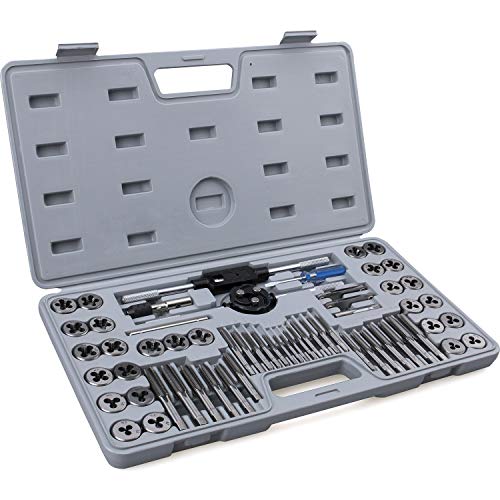
OMT 80-Piece SAE and Metric Tap and Die Set
#4 to 1/2" and M3 to M12, coarse + fine
Under $100
Check Price on Amazon
Budget Pick
OMT 80-Piece SAE and Metric Tap and Die Set
#4 to 1/2" and M3 to M12, coarse + fine
Under $100
Check Price on Amazon
Compare all 6 picks in our best tap and die sets guide →
As an Amazon Associate, WorkshopCalc earns from qualifying purchases. Prices are approximate and can change.
Inch fasteners use the Unified Thread Standard, expressed as threads per inch (TPI). Every nominal size is available in a coarse (UNC) and a fine (UNF) version. The number after the size in a callout is the TPI, for example, 1/4-20 means a 1/4" major diameter with 20 threads per inch (UNC), while 1/4-28 is the fine version. Sizes #12 and smaller are numbered gauges; 1/4" and up are fractional.
| Size | Major Diameter (in) | UNC TPI (Coarse) | UNF TPI (Fine) |
|---|---|---|---|
| #4 | 0.112" | 40 | 48 |
| #6 | 0.138" | 32 | 40 |
| #8 | 0.164" | 32 | 36 |
| #10 | 0.190" | 24 | 32 |
| #12 | 0.216" | 24 | 28 |
| 1/4 | 0.250" | 20 | 28 |
| 5/16 | 0.3125" | 18 | 24 |
| 3/8 | 0.375" | 16 | 24 |
| 7/16 | 0.4375" | 14 | 20 |
| 1/2 | 0.500" | 13 | 20 |
| 9/16 | 0.5625" | 12 | 18 |
| 5/8 | 0.625" | 11 | 18 |
| 3/4 | 0.750" | 10 | 16 |
| 7/8 | 0.875" | 9 | 14 |
| 1" | 1.000" | 8 | 12 |


WorkshopCalc is an Amazon Associate and a Grizzly Industrial affiliate. We earn from qualifying purchases.
A higher TPI means a finer thread. For a given size, UNF always has more threads per inch than UNC. The most common general-purpose inch threads are the UNC values, 1/4-20, 5/16-18, 3/8-16, and 1/2-13.
Metric threads describe pitch as the distance in millimeters between adjacent thread crests, not as TPI. A smaller pitch number means a finer thread. The "M" number is the nominal major diameter in millimeters, so an M8 bolt has an 8mm major diameter. When no pitch is given, the coarse pitch is assumed.
| Size | Major Diameter (mm) | Coarse Pitch (mm) | Fine Pitch (mm) |
|---|---|---|---|
| M3 | 3.0mm | 0.5 | 0.35 |
| M4 | 4.0mm | 0.7 | 0.5 |
| M5 | 5.0mm | 0.8 | 0.5 |
| M6 | 6.0mm | 1.0 | 0.75 |
| M8 | 8.0mm | 1.25 | 1.0 |
| M10 | 10.0mm | 1.5 | 1.25 |
| M12 | 12.0mm | 1.75 | 1.25 |
| M14 | 14.0mm | 2.0 | 1.5 |
| M16 | 16.0mm | 2.0 | 1.5 |
| M20 | 20.0mm | 2.5 | 1.5 |
The classic source of confusion is M10: the coarse pitch is 1.5mm, but M10-1.25 (fine) and M10-1.0 (extra-fine) also exist and look identical to the eye. Always confirm the pitch with a gauge before buying a replacement bolt or nut.
Thread work usually means fabrication. These are the machines that follow.
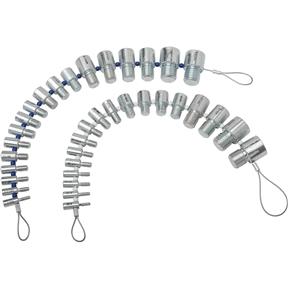
There are three reliable ways to determine the pitch of an unknown thread. For best results, combine a pitch reading with a caliper measurement of the major (outside) diameter.
Both series share the same major diameters; they differ only in how many threads occupy each inch. The choice between coarse and fine affects strength, vibration resistance, speed of assembly, and durability.
A thread callout packs the size, pitch, series, and fit class into a short code. Here is how to decode the two most common formats.
| Callout | What Each Part Means |
|---|---|
| 1/4-20 UNC 2A | 1/4 = major diameter (0.250"). 20 = threads per inch (TPI). UNC = Unified National Coarse series. 2A = fit/tolerance class (A = external thread, e.g. a bolt; B = internal thread, e.g. a nut). Class 2 is the standard general-purpose fit. |
| M8-1.25 | M8 = metric thread, 8mm major diameter. 1.25 = pitch in millimeters (distance crest-to-crest). This is the standard M8 coarse thread; an M8-1.0 would be the fine version. |
In inch callouts, the letter after the class number tells you which part it describes: A is an external thread (bolt or screw) and B is an internal thread (nut or tapped hole). So a bolt is 2A and the matching nut is 2B.
This chart identifies thread pitch and major diameter, but cutting your own internal threads requires drilling a correctly sized hole first. The drill diameter is smaller than the major diameter and is matched to the pitch.
To drill and tap these threads, see our tap drill chart for the exact bit size to use before tapping each UNC, UNF, and metric thread.
View Tap Drill ChartThese tools cover cutting, restoring, measuring, and identifying threads. All links are affiliate links - we may earn a commission at no cost to you.
As an Amazon Associate, WorkshopCalc earns from qualifying purchases. This helps support the site at no additional cost to you. We only recommend products we would use in our own workshops.
Tap drill sizes plus fractional, number, letter, and metric drill bits.
View Chart →Recommended torque values by bolt size, grade, and thread series.
View Chart →SAE and metric socket sizes matched to bolt and nut head sizes.
View Chart →Browse every WorkshopCalc reference chart in one place.
Browse All →Updated 2026. Thread pitch is the distance from one thread crest to the next. Inch threads give it as TPI (threads per inch) and metric threads give it in millimeters, and the two convert with one formula: pitch in mm = 25.4 / TPI, and TPI = 25.4 / pitch in mm. For example, 20 TPI is 25.4 / 20 = 1.27 mm, and an M8 x 1.25 thread is 25.4 / 1.25 = 20.3 TPI. The two are never exactly equal, so inch and metric fasteners do not swap even when the pitch looks close.
| TPI | Pitch (mm) | Pitch (in) | Common Sizes at This TPI |
|---|---|---|---|
| 8 | 3.175 mm | 0.1250" | 1" UNC |
| 9 | 2.822 mm | 0.1111" | 7/8" UNC |
| 10 | 2.540 mm | 0.1000" | 3/4" UNC |
| 11 | 2.309 mm | 0.0909" | 5/8" UNC |
| 12 | 2.117 mm | 0.0833" | 9/16" UNC, 1" UNF |
| 13 | 1.954 mm | 0.0769" | 1/2" UNC |
| 14 | 1.814 mm | 0.0714" | 7/16" UNC, 7/8" UNF |
| 16 | 1.587 mm | 0.0625" | 3/8" UNC, 3/4" UNF |
| 18 | 1.411 mm | 0.0556" | 5/16" UNC, 9/16" UNF, 5/8" UNF |
| 20 | 1.270 mm | 0.0500" | 1/4" UNC, 7/16" UNF, 1/2" UNF |
| 24 | 1.058 mm | 0.0417" | #10 UNC, 5/16" UNF, 3/8" UNF |
| 28 | 0.907 mm | 0.0357" | 1/4" UNF |
| 32 | 0.794 mm | 0.0312" | #6 UNC, #8 UNC, #10 UNF |
| 40 | 0.635 mm | 0.0250" | #4 UNC, #6 UNF |
Pipe threads use their own TPI values and are tapered (NPT) or parallel/tapered (BSP), so they are not on the bolt charts above. NPT has a 60 degree thread form and BSP has a 55 degree form, so the two will not seal against each other even when the TPI matches (1/2" and 3/4" are both 14 TPI in either standard).
| Nominal Pipe Size | NPT TPI | BSP TPI |
|---|---|---|
| 1/8" | 27 | 28 |
| 1/4" | 18 | 19 |
| 3/8" | 18 | 19 |
| 1/2" | 14 | 14 |
| 3/4" | 14 | 14 |
| 1" | 11.5 | 11 |
Thread pitch describes how fine or coarse a thread is. For inch (imperial) threads, pitch is expressed as TPI, threads per inch, so a higher number means finer threads. For metric threads, pitch is the distance in millimeters between two adjacent thread crests, so a smaller number means finer threads. For example, a 1/4-20 bolt has 20 threads per inch, while an M8 coarse bolt has a 1.25mm pitch.
UNC (Unified National Coarse) and UNF (Unified National Fine) are the two main inch thread series. UNC has fewer threads per inch (coarser), while UNF has more threads per inch (finer). A 1/4-20 is UNC and a 1/4-28 is UNF, even though both are 1/4 inch in diameter. Coarse UNC threads are stronger in soft materials, faster to assemble, and more tolerant of damage and dirt. Fine UNF threads resist vibration loosening, allow finer adjustment, and have higher tensile strength in the same diameter.
A standard M8 coarse bolt has a thread pitch of 1.25mm, meaning there is 1.25mm between adjacent thread crests. The common M8 fine pitch is 1.0mm. The full callout for the standard bolt is M8-1.25, and a fine version is M8-1.0. If a pitch is not specified, coarse (1.25mm) is assumed for M8.
The fastest way is to use a thread pitch gauge: try each leaf against the threads until one seats perfectly into the grooves with no gaps, then read the TPI or mm value stamped on that leaf. Without a gauge, for inch threads count the number of thread crests in one inch to get TPI, and for metric threads measure the distance from one crest to the next in millimeters. Combine the pitch reading with a caliper measurement of the major (outside) diameter to fully identify the thread.
It depends on how you define strength. Fine threads have a slightly larger minor diameter and more thread engagement, giving them higher tensile and stripping strength for the same nominal size, plus better resistance to vibration loosening. Coarse threads are stronger and more reliable in soft or brittle materials like aluminum, cast iron, and plastic, install faster, and tolerate nicks, dirt, and corrosion far better. For most general workshop and structural use, coarse threads are the safer default.
Divide 25.4 by the TPI. A 20 TPI thread has a pitch of 25.4 / 20 = 1.27 mm, and 13 TPI (a 1/2-13 UNC bolt) is 1.954 mm. To go the other way, divide 25.4 by the pitch in mm: M10 x 1.5 is about 16.9 TPI.
The 1/8 inch NPT pipe thread has 27 threads per inch. The 1/8 inch BSP pipe thread is 28 TPI, so the two are close but not interchangeable. Measure with a thread pitch gauge to be sure which one you have.
A 1/2 inch NPT pipe thread has 14 threads per inch (a pitch of about 1.81 mm), the same as 3/4 inch NPT. Note that a 1/2 inch bolt is a different thread: 1/2-13 UNC or 1/2-20 UNF.
They describe the same thing in different units. Inch threads use TPI (a higher number means a finer thread), and metric threads use pitch in mm (a higher number means a coarser thread). That is why M8 x 1.25 is coarser than M8 x 1.0, but 1/4-28 is finer than 1/4-20.